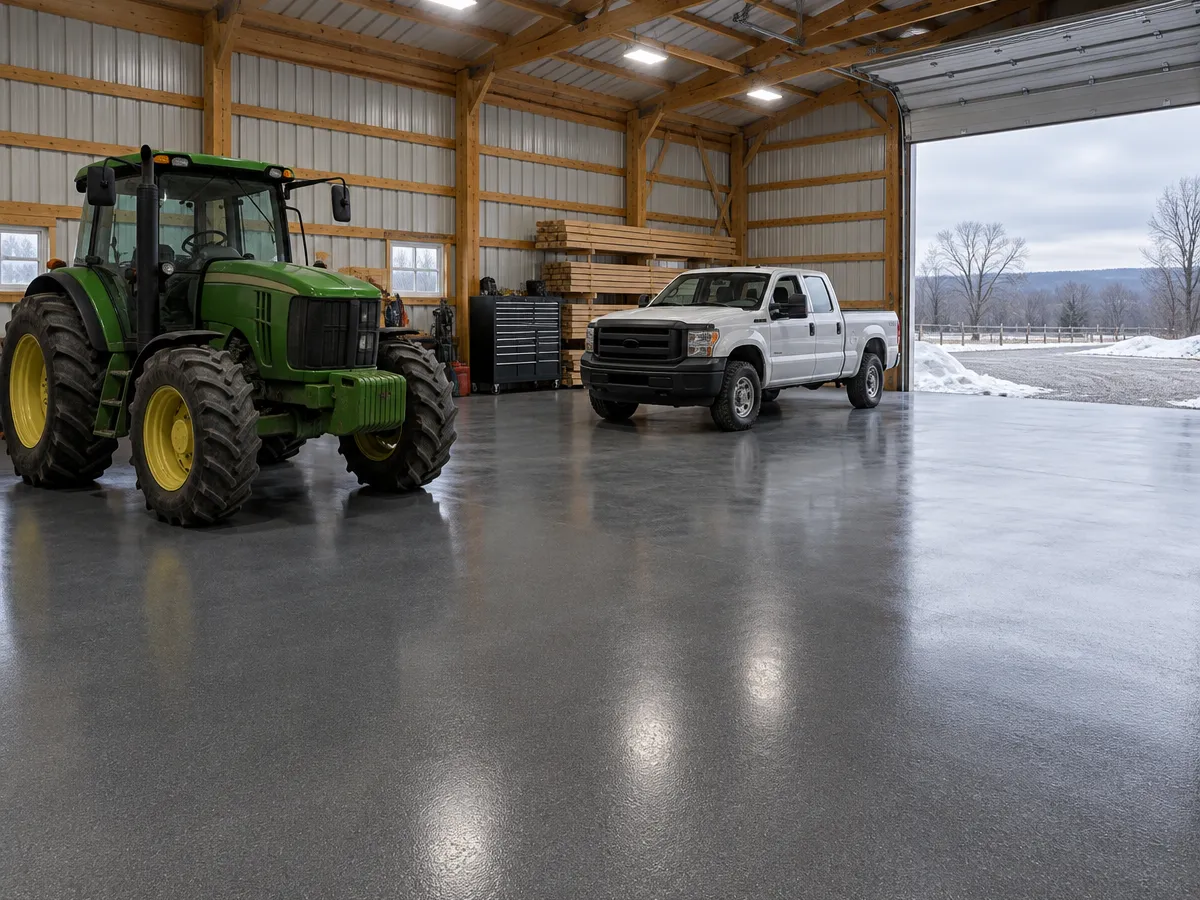
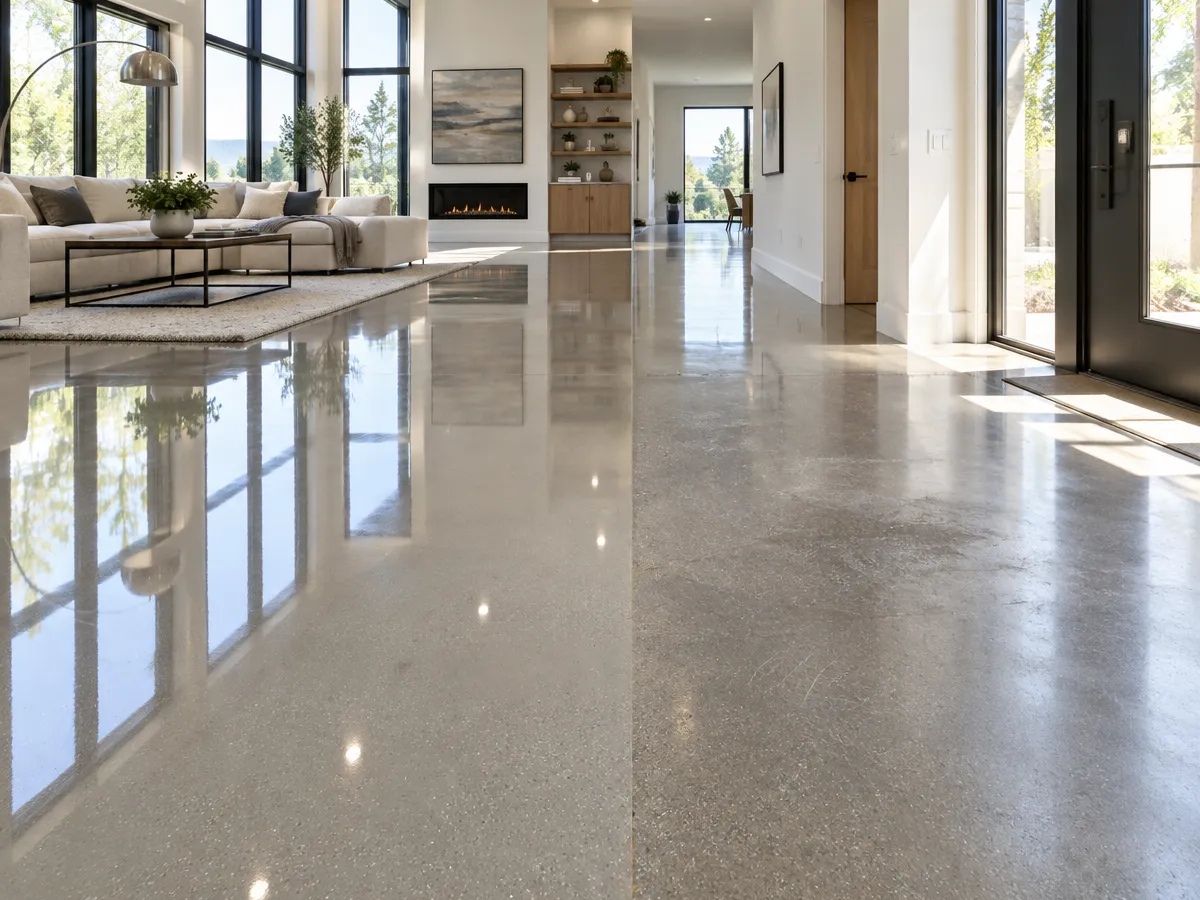
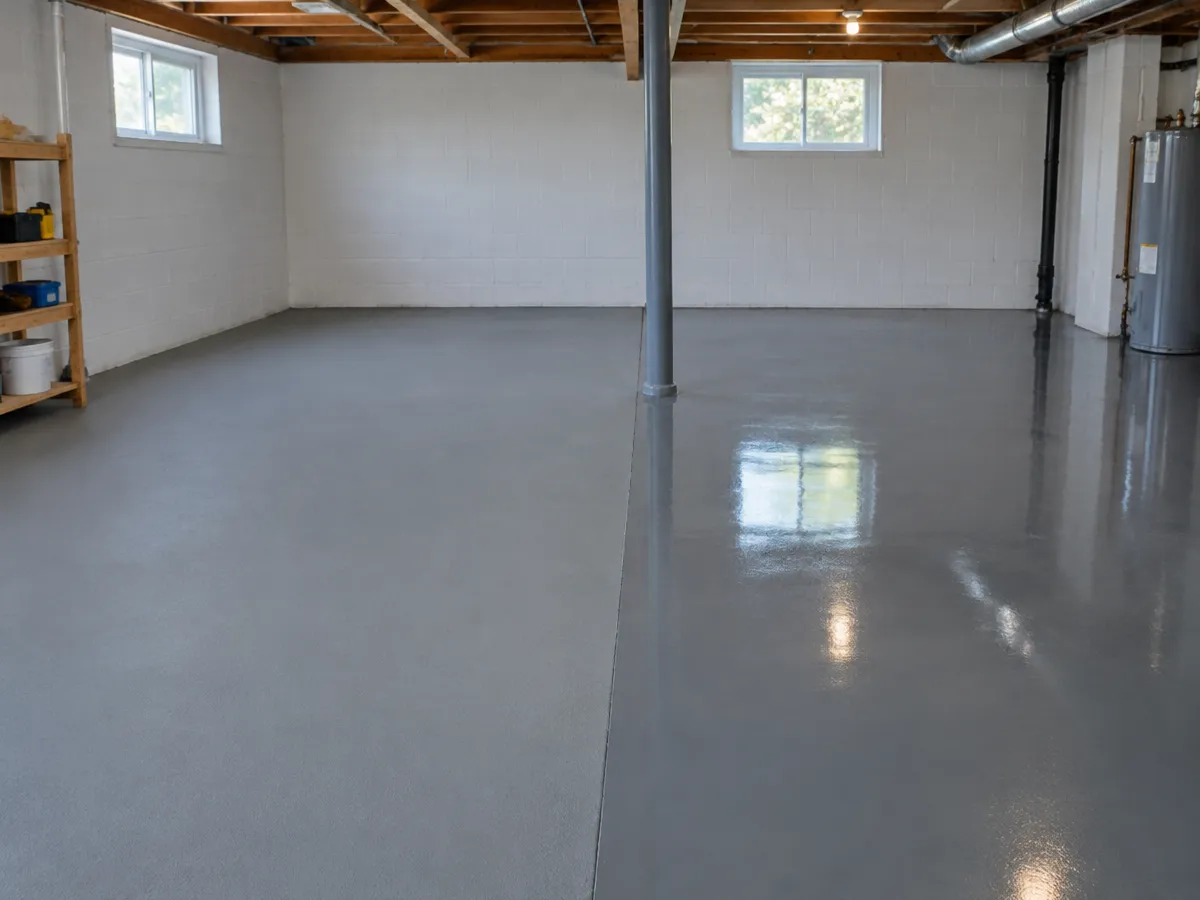
Quick Answer: For most rural Western Pennsylvania pole barns and shops, the best pole barn floor epoxy option is a polyurea basecoat with a UV-stable polyaspartic clear coat, installed over diamond-ground, crack-repaired concrete. It handles point loads from jack stands and equipment better than standard epoxy, resists chemicals and abrasion, and allows foot traffic in about 12 hours. For the heaviest loads, a sand- or quartz-reinforced build adds compressive strength. Slab preparation matters as much as the coating itself.
Why do pole barn floors fail in Western PA?
Pole barn floors fail when concentrated weight overwhelms the coating’s compressive strength. Barn and pole buildings routinely absorb heavy point loads from jack stands, heavy equipment, and metal horse shoes, and those loads land on a very small footprint.
Pole barn floor epoxy and similar thin-film systems often carry the same or less compressive strength as the concrete beneath them. A high point load can therefore exceed what the coating can bear. Once that threshold is crossed, the surface gives way under the load rather than flexing with it. Western Pennsylvania properties that store tractors, lifts, and shop equipment face this pressure daily.
What causes a coating to fail under point load?
Point load is a force applied to one concentrated spot. A jack stand or a horse shoe presses down through a tiny contact area, so the stress per square inch climbs fast. When the coating’s compressive strength sits at or below the slab’s, the coating absorbs the damage first.
How do installers build a floor for heavy point loads?
Property owners in Western Pennsylvania can reduce this risk by specifying a system built for the load, not just a standard coating. Follow these steps:
- Identify the heaviest point loads the barn will see, including equipment, stands, and livestock.
- Compare those loads against the compressive strength of the proposed coating.
- Specify a sand or quartz reinforced coating, or a mortar system, when higher point-load tolerance is required.
- Address winter-related surface damage as part of the same preparation, since road salt accelerates spalling and internal corrosion.
A reinforced system gives the floor a better chance of carrying concentrated weight without failing.
What is the best pole barn floor epoxy system?
A polyurea basecoat topped with a UV-stable polyaspartic clear coat is the best system for most pole barn floors in Western Pennsylvania. Polyurea basecoats deliver significantly stronger bond strength and impact resistance than standard epoxy, which makes them ideal for demanding environments.
Rural property owners across Western Pennsylvania ask for pole barn floor epoxy by name, but the chemistry underneath the name matters more than the label. The basecoat determines how the floor handles dropped tools, heavy equipment, and chemical spills. The topcoat determines how the surface ages under sunlight and abrasion.
How does a polyurea basecoat compare to standard epoxy?
Polyurea outperforms standard epoxy on bond strength and impact resistance. That gap matters in a machine shed or workshop where concentrated loads and constant traffic punish the slab. Epoxy remains a lower-cost option for lighter-traffic commercial spaces, but polyurea is the stronger long-term choice for busy environments.
| System | Best Fit | Trade-Off |
|---|---|---|
| Standard epoxy | Lighter-traffic spaces | Lower cost, weaker impact resistance |
| Polyurea basecoat | Busy workshops and machine sheds | Higher upfront investment |
| Polyurea plus polyaspartic clear | Demanding, sun-exposed floors | Full system cost |
Pricing note: The cost comparisons in this article are for general guidance only. Actual costs vary based on slab size and condition, the repairs required, and the system selected, and pricing can change at any time. Contact Specialty Concrete Coatings for a current, accurate quote.
Why add a polyaspartic clear coat?
A polyurea basecoat paired with a UV-stable polyaspartic clear coat resists yellowing, abrasion, and chemicals. The clear coat seals the system and protects the color and texture beneath it. For a closer look at how these systems perform under vehicle traffic, see this polyurea versus epoxy comparison.
How should a Western Pennsylvania owner choose a system?
- Identify the heaviest traffic the floor will see, including equipment and vehicle loads.
- Match the basecoat to that load, choosing polyurea for demanding use.
- Confirm a UV-stable polyaspartic clear coat tops the system.
- Request a free quote and color selection guidance before scheduling.
📞 Ready to Get Started? Planning a pole barn or shop floor in rural Western PA? Specialty Concrete Coatings provides free on-site assessments and quotes. Request your free shop floor quote.
How do you prepare a pole barn slab?
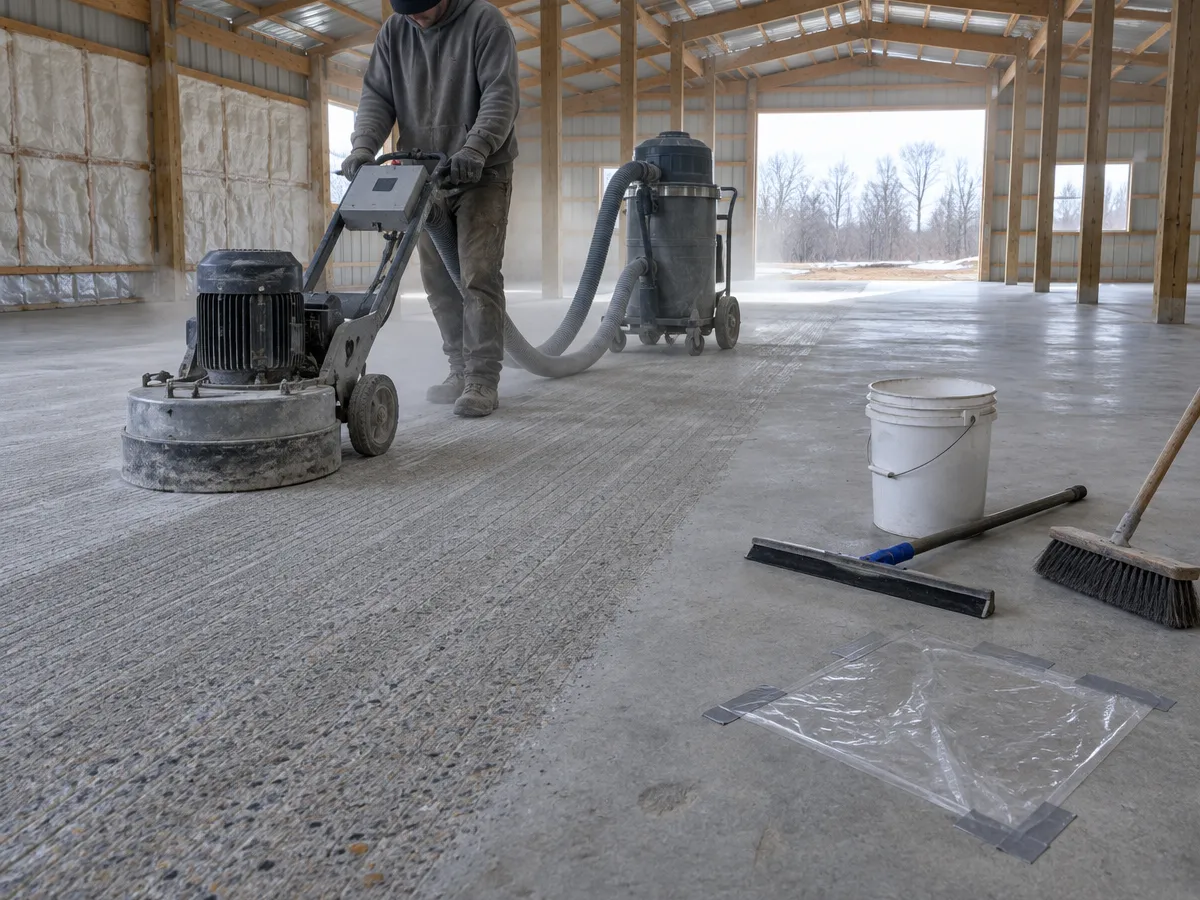
Preparation begins with diamond grinding, not with a coating. Crews mechanically prepare the entire concrete surface before any product touches the slab, because a pole barn floor epoxy system bonds only to concrete that is clean, profiled, and sound.
Western Pennsylvania pole barns often carry years of hard use. Slabs show cracking and staining from vehicle and equipment traffic, and that damage must be addressed before a new floor system can perform. Skipping this stage traps the old wear under a fresh surface, and the coating fails from below.
What does diamond grinding do to a pole barn slab?
Diamond grinding mechanically prepares the concrete by opening the surface profile. Installers grind the full slab with diamond tooling, working section by section. Crews grind around support posts, floor drains, and anything permanently mounted to the floor, so no area is left unprepared.
How are cracks and spalls handled before coating?
Cracks and spalls are repaired with concrete menders before the basecoat goes down. Repairing these defects restores a sound substrate for the high-adhesion basecoat that follows. The sequence matters, and the company follows it on every installation.
Moisture is the other slab question. Many pole barn floors were poured without a vapor retarder underneath, so moisture can rise through the concrete. The American Concrete Institute’s guide to concrete floor and slab construction explains why vapor retarders matter, and bond strength on a prepared slab can be verified with a pull-off adhesion test when a project calls for it.
The full preparation sequence follows a fixed order:
- Grind the entire slab with diamond grinding equipment, section by section.
- Work around support posts, floor drains, and permanently mounted fixtures.
- Repair cracks and spalls with concrete menders.
- Apply the high-adhesion basecoat to the prepared surface.
Each step builds on the one before it. Proper preparation sets up the fast return to service that Western Pennsylvania property owners expect.
What steps install a durable pole barn coating?
Installing a durable pole barn floor epoxy system follows a disciplined, multi-step process. The procedure transforms bare, damaged concrete into a high-performance surface that withstands heavy equipment, chemical spills, and constant traffic. Skipping any single step compromises the entire floor’s longevity.
What preparation does the concrete require before coating?
Mechanical preparation is the foundation of every successful installation. The crew grinds the entire slab with diamond tooling to open the concrete’s pores and remove surface contaminants. Cracks and spalls receive repair with concrete menders, restoring a uniform substrate. A high-adhesion basecoat then bonds directly to the prepared surface, creating the system’s structural core.
How are color and texture added to the floor?
Aesthetics and safety arrive in a single, critical step. Vinyl color chips are hand-broadcast into the wet basecoat, allowing customized color blends that match the building’s purpose. This broadcast also delivers essential slip resistance for workshops and equipment bays. Once the basecoat cures, technicians scrape away excess chips. The result is a uniform texture free of loose debris, ready for the final protective layer.
What seals and protects the finished coating?
A final clear coat seals the entire system. This top layer locks in the color chips and provides the primary defense against abrasion, moisture, and chemical attack. For pole barns housing vehicles or livestock, this sealed surface resists the point loads and staining that destroy unprotected concrete. The same core process applies whether the project is a residential garage or a full commercial building, though larger spaces demand careful section-by-section planning to maintain consistent quality across the slab. Winter conditions add another threat; salt dragged in on tires accelerates surface degradation, making a fully sealed system critical for Western Pennsylvania properties.
How fast can you return to work?
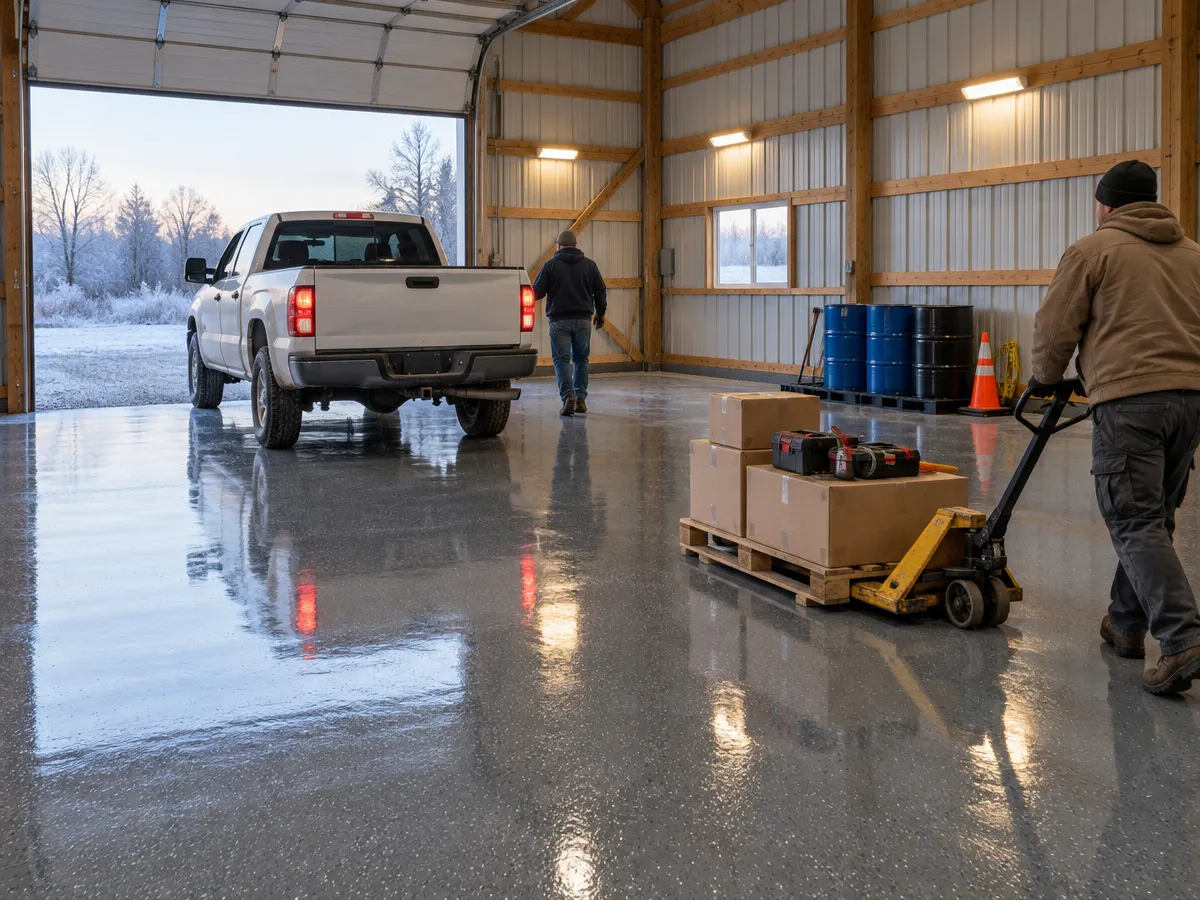
A pole barn floor epoxy project with Specialty Concrete Coatings typically allows foot traffic in about 12 hours. The company’s one-day installation capability keeps most Western Pennsylvania barns, machine sheds, and workshops out of service for a single workday rather than a week.
The schedule follows a fixed sequence. Property owners in Greater Pittsburgh and rural Western PA can plan around these milestones:
- Walk on the surface after approximately 12 hours.
- Move heavier items back onto the floor after approximately 24 hours.
- Drive vehicles on the coating within approximately 48 hours in garage applications.
That timeline depends on a polyurea basecoat paired with a UV-stable polyaspartic clear coat. Specialty Concrete Coatings reports that most shops can walk on the floor in about 12 hours and drive on it within 48 hours with this system. For a closer look at how coating choices affect scheduling and budget, the guide to Pittsburgh garage floor coating pricing breaks down the options.
Can heavy equipment go back in sooner?
Heavier items wait until roughly the 24-hour mark. Jack stands, lifts, and loaded pallets concentrate weight on small contact points, so the coating needs that extra curing window before bearing them. Moving equipment early risks marring a fresh surface.
Does cold Western PA weather slow the cure?
Cooler temperatures in Northwest Pennsylvania can extend cure times beyond the standard windows. The company confirms actual return-to-service timing during the free quote and on-site assessment.
Frequently Asked Questions
What causes pole barn floor coatings to fail under heavy equipment?
Concentrated weight from jack stands, equipment, or horse shoes can overwhelm a coating’s compressive strength, causing the surface to give way under the load.
What is the best pole barn floor epoxy system for Western Pennsylvania?
A polyurea basecoat topped with a UV-stable polyaspartic clear coat delivers stronger bond strength and impact resistance than standard epoxy.
How long does a pole barn floor coating take to cure?
Most shops can walk on the floor in about 12 hours, move heavier items back after about 24 hours, and drive on it within about 48 hours. Cooler Northwest Pennsylvania temperatures can extend those windows.
Can a pole barn floor coating handle road salt and fuel spills?
A sealed polyurea and polyaspartic system resists chemicals and abrasion, and a fully sealed surface helps limit damage from salt carried in on tires. Cleaning up spills promptly still extends the life of any floor.
Does a pole barn slab need repairs before coating?
Usually. The slab is diamond ground and cracks and spalls are repaired with concrete menders before the basecoat goes down, so the coating bonds to sound concrete.
TL;DR — Pole Barn Floor Coatings at a Glance
- Heavy point loads from jack stands, lifts, and equipment are the main reason pole barn coatings fail.
- A polyurea basecoat with a polyaspartic clear coat outperforms standard epoxy on bond strength and impact resistance.
- Diamond grinding and crack repair come before any coating touches the slab.
- Slabs poured without a vapor retarder deserve a moisture check before coating.
- Most floors are walkable in about 12 hours and drivable in about 48 hours.
- Ready to upgrade your barn or shop? Call Specialty Concrete Coatings for a free quote.
Related Resources
- Industrial Shop Floor Coatings
- Meadville, PA Concrete Coatings
- Protecting Your Workshop Floors With Heavy-Duty Coatings
- Auto Shop Floor Coating With Polyurea
- Winter Salt Damage on Garage Floors in PA
- Polyurea Concrete Coating Explained
Get a Free Pole Barn Floor Coating Quote
A pole barn floor coating in Western Pennsylvania delivers lasting performance only when the full preparation and installation sequence is followed, from diamond grinding through the final clear coat. Property owners who choose this disciplined approach gain a surface that resists heavy equipment, chemical spills, and salt damage while returning to service within a single workday. The decision to invest in proper mechanical preparation and a polyurea-based system determines whether the floor endures years of hard use or fails prematurely under concentrated loads.
Contact Specialty Concrete Coatings to schedule a free assessment of your pole barn or shop floor.
About Specialty Concrete Coatings: Specialty Concrete Coatings LLC transforms residential and commercial concrete across Greater Pittsburgh and Northwest Pennsylvania with durable polyurea and epoxy systems engineered for fast return to service. The team handles diamond grinding, crack repair, and installation in-house, with free quotes, financing options, and a warranty program.