Quick Answer: Auto shop floor coating protects concrete from hot tires, dropped tools, and chemical spills, and polyurea outperforms epoxy in high-traffic garages because it cures faster, resists impact better, and holds up longer under constant vehicle and foot traffic. Specialty Concrete Coatings pairs a polyurea basecoat with a UV-stable polyaspartic clear coat, so most shops can walk on the floor in about 12 hours and drive on it within 48 hours. Epoxy remains a lower-cost option for lighter-traffic commercial spaces, but polyurea is the stronger long-term choice for busy automotive bays.
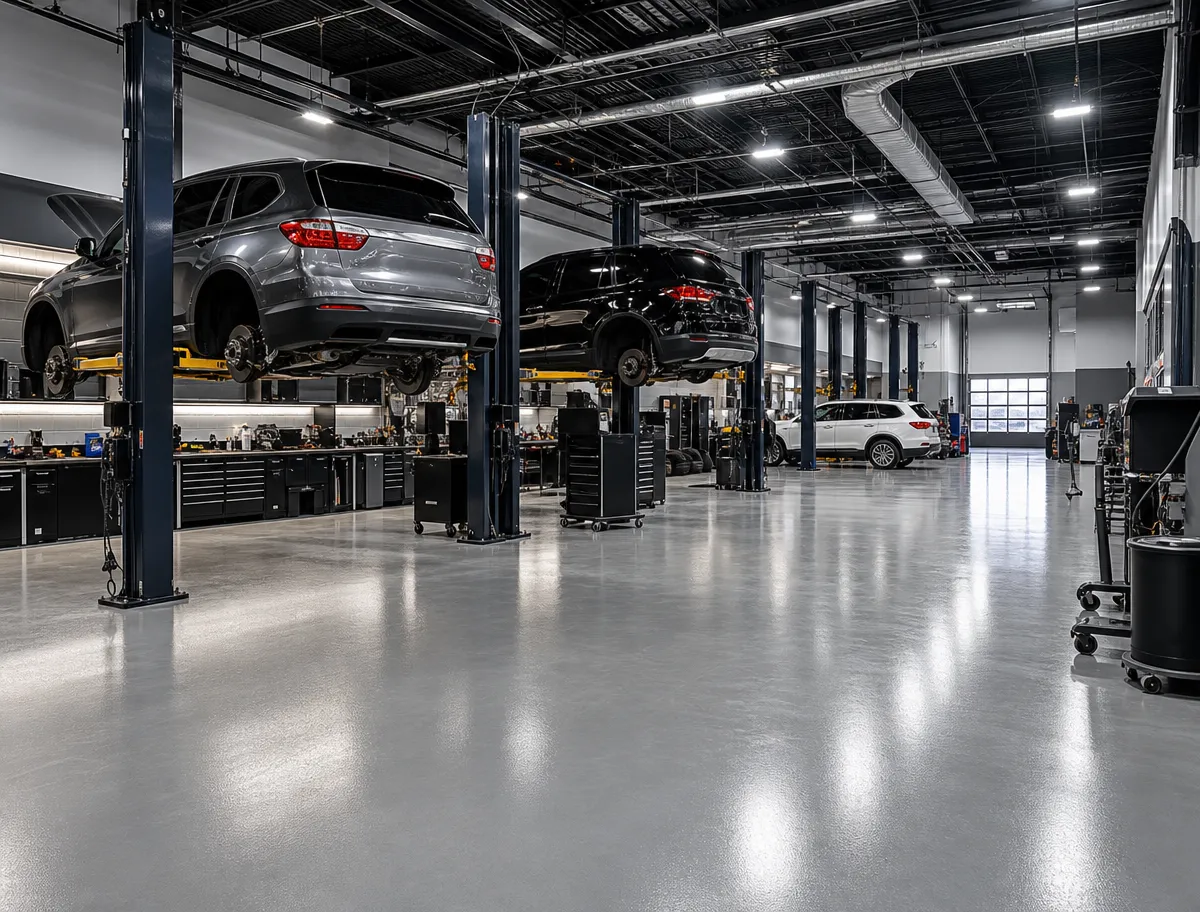
Polyurea basecoats deliver significantly stronger bond strength and impact resistance than standard epoxy, making them ideal for auto shops facing constant vehicle traffic, dropped tools, and chemical spills. Specialty Concrete Coatings LLC pairs a polyurea basecoat with a UV-stable polyaspartic clear coat, cutting downtime to roughly 12 hours before foot traffic and 48 hours before vehicles return.
What Are the Key Takeaways on Polyurea vs. Epoxy for Auto Shops?
- Polyurea cures dramatically faster than epoxy, often ready for foot traffic in as little as 12 hours versus epoxy’s 24-72 hour cure window.
- Polyurea basecoats test at up to five times the strength of standard epoxy, resisting hot tires, dropped tools, and rolling jacks better in high-traffic auto shops.
- A UV-stable polyaspartic clear coat over polyurea resists yellowing and abrasion, keeping shop floors looking new for years under fluorescent lighting.
- Epoxy remains a solid, budget-friendly choice for lower-traffic environments like retail stores, offices, and schools.
- Choosing the wrong coating system risks premature peeling, staining, and costly reapplication.
Why Does Auto Shop Floor Coating Matter So Much?
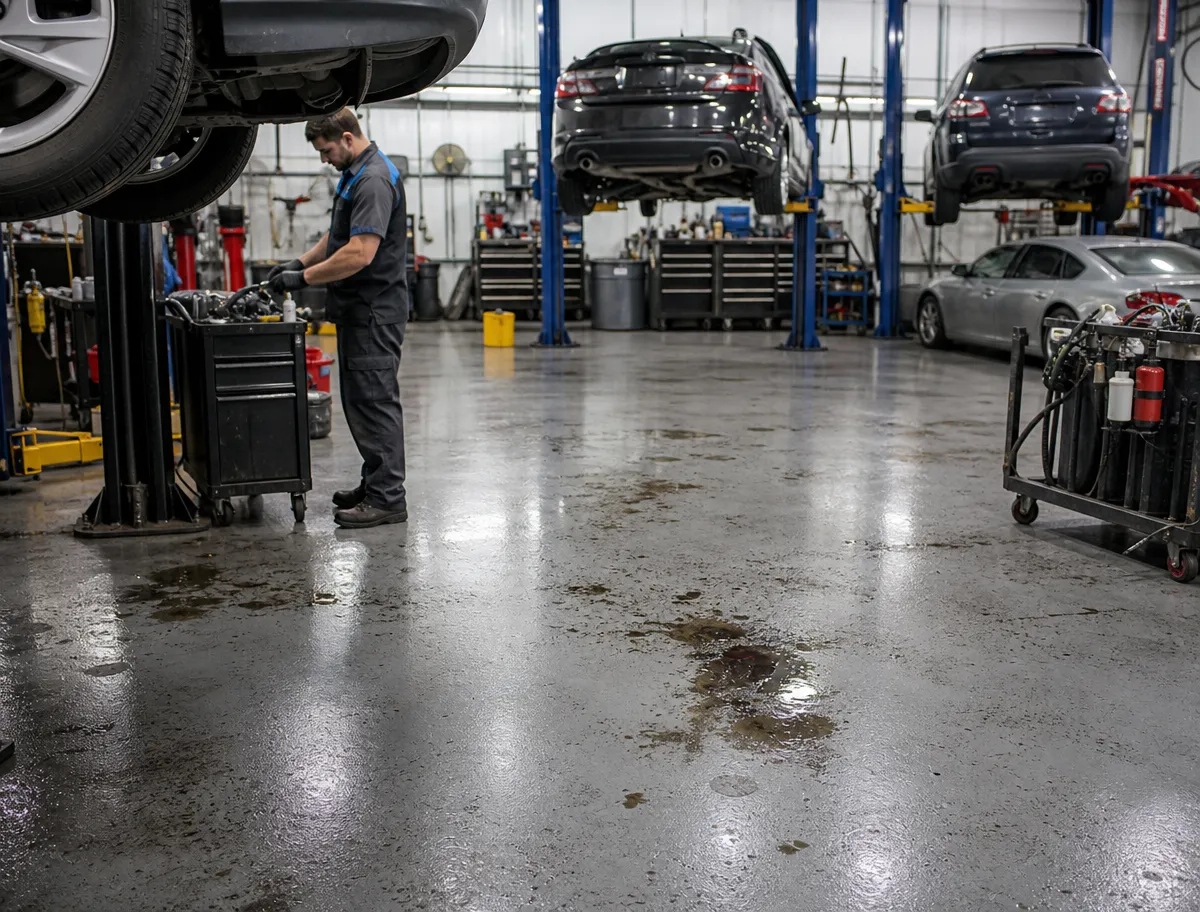
Bare concrete fails fast under hot tires, dropped tools, and constant chemical spills. Auto shop floor coating solves that problem by creating a durable barrier engineered for exactly this kind of abuse. Specialty Concrete Coatings LLC builds high-performance floor finishes for automotive shops and other demanding commercial environments, backed by more than 15 years of experience installing systems designed for fast return to service.
Unprotected concrete absorbs oil, brake fluid, and coolant, leaving stains that never fully lift out. Protective coatings change that equation. They significantly enhance surface durability and cut down on the environmental and mechanical wear a working industrial shop flooring system sees every day.
Which coating type holds up best in an auto shop?
Polyurea and epoxy both deliver strong protection for commercial floors, but performance shifts depending on the shop’s operational demands. A high-turnover bay with heavy foot and vehicle traffic asks more of a coating than a low-traffic storage area.
Factors that determine the right system:
- Traffic volume and vehicle weight
- Exposure to chemicals, oils, and solvents
- Downtime tolerance during installation
- Desired appearance and slip resistance
Choosing the wrong system means premature peeling, staining, or costly reapplication – losses no shop owner wants to absorb twice.
Which Coating Performs Better For Auto Shop Floors?
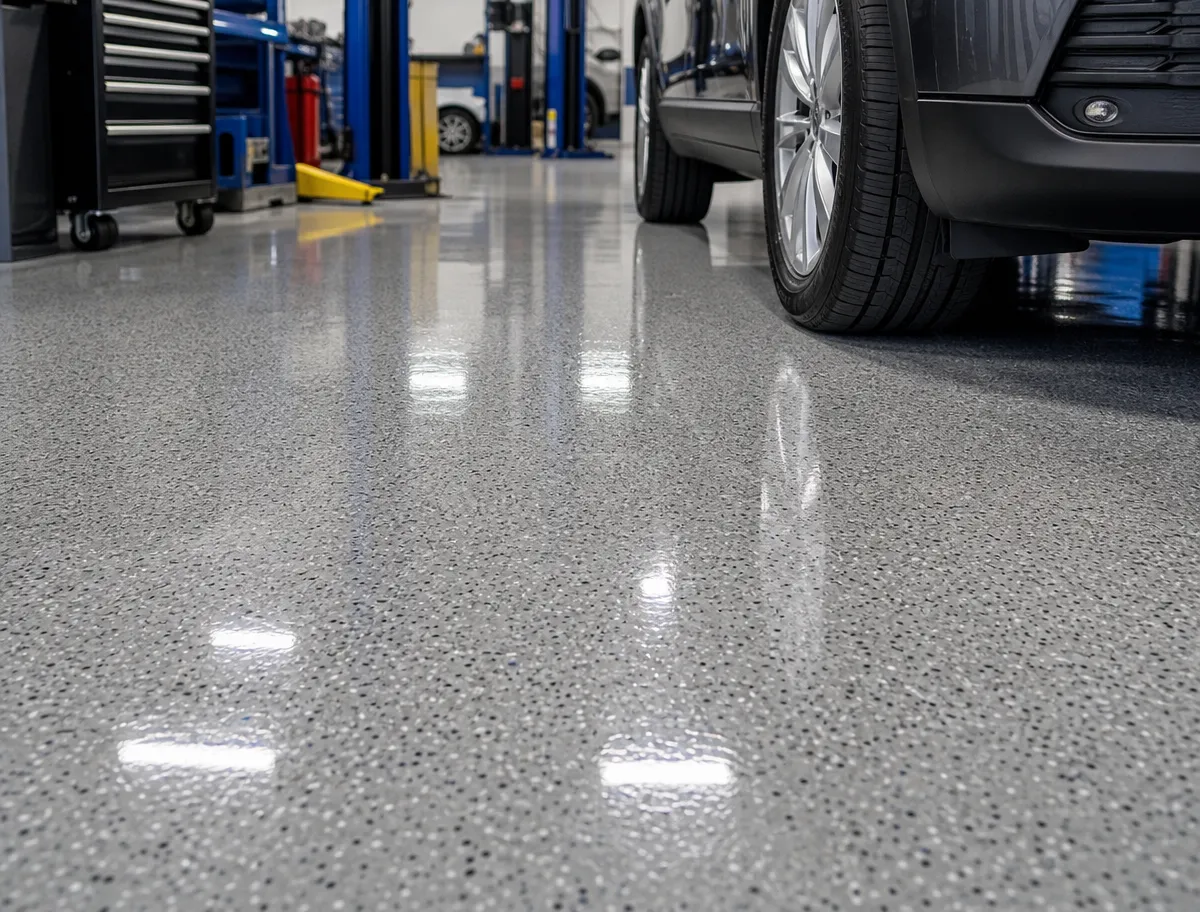
Polyurea outperforms epoxy for auto repair environments, standing up to dropped tools, rolling jacks, and chemical spills with far greater resistance. Specialty Concrete Coatings LLC builds its auto shop floor coating systems around a polyurea basecoat, engineered to be significantly stronger than traditional epoxy. Independent research on how epoxy, polyurea, and polyaspartic coatings differ backs this up, showing polyurea coatings test at up to five times the strength of standard epoxy in demanding environments – a margin that matters in a shop where a floor gets hit daily by hot tires, transmission fluid, and dropped impact wrenches.
A UV-stable polyaspartic clear coat seals every installation, guarding against yellowing, abrasion, and chemical exposure. That resistance is backed by published research on the long-term degradation resistance of polyurea coatings, and under fluorescent shop lighting it keeps the floor looking new instead of clouding or amber-tinting within a year or two.
Polyurea vs. Epoxy: Side-by-Side Comparison
| Factor | Polyurea | Epoxy |
| Cure Time | 12 hrs (foot) / 48 hrs (vehicle) | 24-72 hours |
| Impact Strength | Up to 5x standard epoxy | Good, but lower impact tolerance |
| Chemical & Oil Resistance | Excellent | Good |
| UV Stability (with polyaspartic topcoat) | Excellent – resists yellowing | Can yellow/amber over time |
| Best For | High-traffic auto shops, garages | Offices, retail, light-duty spaces |
| Typical Upfront Cost | Higher | Lower |
Is epoxy ever the right choice for a garage or shop?
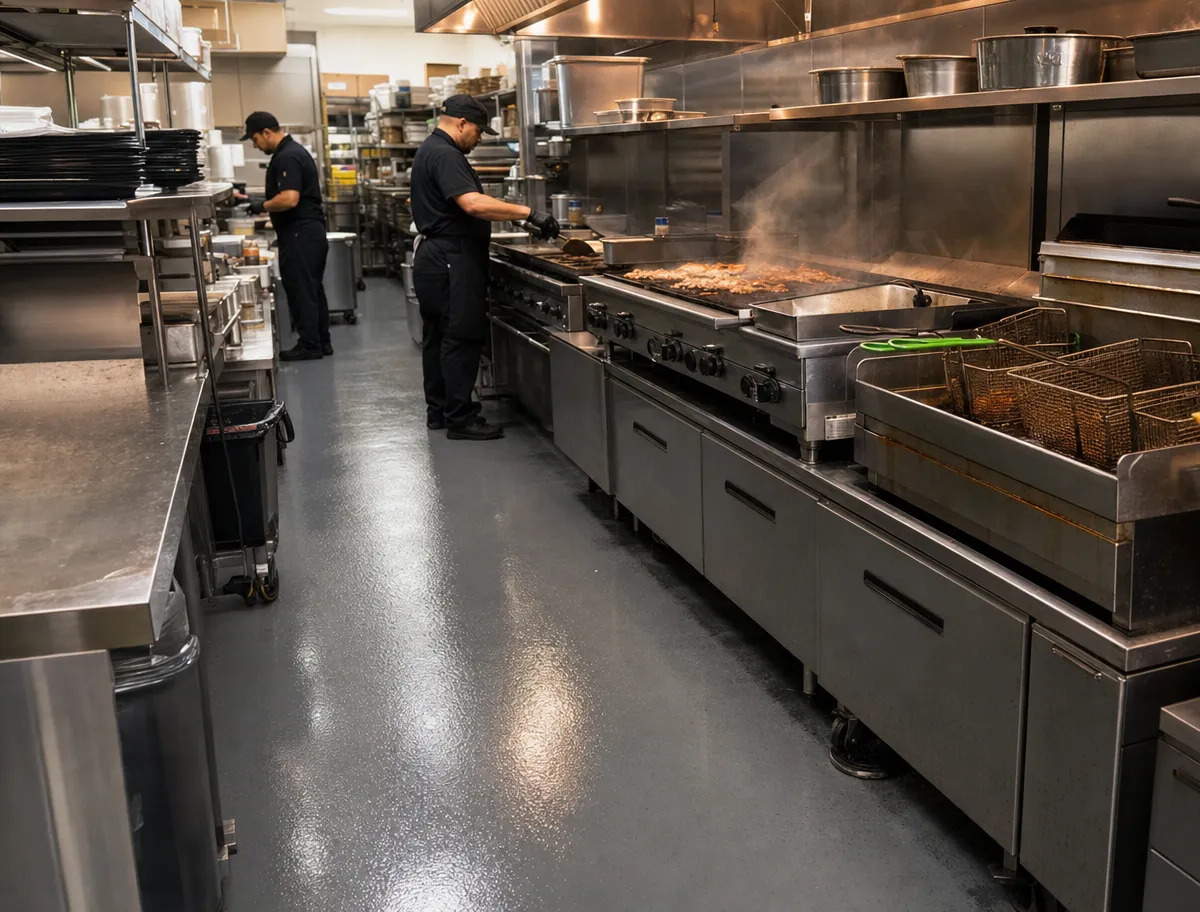
Epoxy still has a place. Marketed as a budget-friendly option, it suits large retail stores, offices, and schools where foot traffic dominates over heavy mechanical wear. Shops chasing the lowest upfront cost sometimes lean toward epoxy for that reason. Epoxy resins also carry additional handling and exposure considerations worth understanding before installation.
Why does downtime matter when comparing these coatings?
Epoxy systems typically demand 24 to 72 hours of cure time before the floor handles full use again – a costly gap for a shop billing hourly labor. Polyurea’s faster-curing chemistry keeps bays closer to operational, a critical edge for facility operators who cannot afford idle lifts.
📞 Ready to Get Started? Don’t let slow cure times or a weak coating shut your bays down longer than necessary. Contact Specialty Concrete Coatings today for a fast, free quote on polyurea auto shop floor coating.
What Should Auto Shops Expect During Installation?
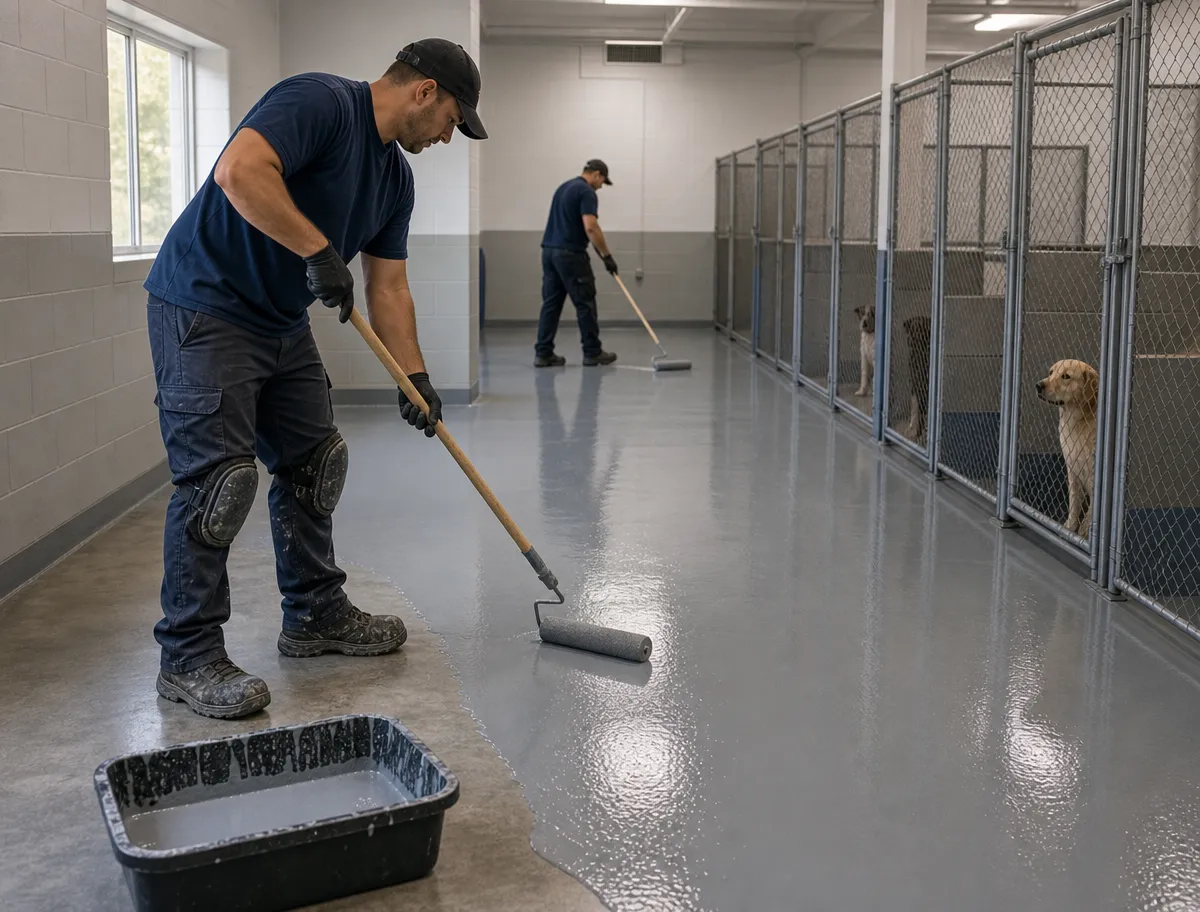
Installation day starts with mechanical preparation, not paint. Crews diamond grind the concrete surface to open the pores for adhesion, then repair cracks and spalls with concrete menders before any coating touches the floor. Skipping this step causes premature peeling; Specialty Concrete Coatings builds the process around it instead.
Once the basecoat cures, vinyl color chips get hand-broadcast across the surface. This step creates a custom look while adding slip resistance underfoot, a real safety factor around lifts, tools, and fluid spills. Excess chips are scraped away for an even texture, then a clear topcoat seals everything for chemical and abrasion resistance. Full pricing details for the polyaspartic topcoat are covered in our polyaspartic floor coating cost breakdown.
How long does an auto shop floor stay out of service?
Downtime stays short by design. Shops can typically walk on the new auto shop floor coating in about 12 hours, move heavier equipment back after 24 hours, and drive vehicles on it within 48 hours. For a deeper look at how polyurea concrete coating works, see our full explainer.
What happens before installation begins?
Every project starts with a free quote and a walkthrough of the space. From that first consultation through final cleanup, the team manages material selection, scheduling, and on-site execution, leaving shop owners with one point of contact throughout. Shop owners can request a free quote before committing to a project.
When selecting a floor coating for your automotive shop, the choice between polyurea and epoxy ultimately reflects your priorities: epoxy offers proven affordability and adequate performance for moderate-duty environments, while polyurea delivers superior strength, faster cure times, and extended durability under demanding conditions. Both systems, when professionally installed with proper surface preparation and multi-layer application, transform concrete into a resilient, attractive surface that supports your shop’s operations and reputation for years to come.
TL;DR – Polyurea vs. Epoxy at a Glance
- Polyurea cures in about 12 hours for foot traffic and 48 hours for vehicles, compared with epoxy’s 24-72 hour cure window.
- Polyurea basecoats test up to 5x stronger than standard epoxy, better resisting dropped tools, rolling jacks, and hot tires.
- A UV-stable polyaspartic clear coat protects against yellowing, abrasion, and chemical exposure for years.
- Epoxy remains a budget-friendly option for lower-traffic spaces like offices, retail stores, and schools.
- Proper surface prep – diamond grinding and crack repair – is essential to prevent premature peeling regardless of coating type.
- Next step: Contact Specialty Concrete Coatings for a free walkthrough and quote on your auto shop floor coating project.
Frequently Asked Questions
Is polyurea or epoxy stronger for auto shop floors?
Polyurea is significantly stronger, testing at up to five times the strength of standard epoxy. Specialty Concrete Coatings LLC pairs its polyurea basecoat with a UV-stable polyaspartic clear coat for added durability.
How long does an auto shop stay closed during polyurea installation?
Specialty Concrete Coatings LLC’s polyurea system cuts downtime to roughly 12 hours before foot traffic and 48 hours before vehicles return, minimizing lost shop time.
Does epoxy work for any type of shop?
Epoxy suits large retail stores, offices, and schools where foot traffic dominates over heavy mechanical wear, and offers a budget-friendly option for cost-conscious buyers.
How much does auto shop floor coating cost?
Cost varies by shop size, surface prep needs, and coating system selected. Polyurea systems often carry a higher upfront cost than epoxy but can reduce long-term expenses through faster cure times and fewer reapplications. Contact Specialty Concrete Coatings for a free, no-obligation quote tailored to your shop.
How do I maintain a polyurea auto shop floor coating?
Routine maintenance is minimal: sweep or dust-mop regularly, wipe up spills promptly, and use a pH-neutral cleaner for deeper cleaning. Polyurea’s UV-stable polyaspartic topcoat resists staining and abrasion, so most shops need only periodic cleaning rather than reapplication.
Related Resources
- Automotive Shop Floor Coatings
- Concrete Coating in Pittsburgh, PA Service Area
- Choosing Between Epoxy and Polyurea for Your Garage Floor
- What Homeowners Don’t Know About Polyurea and Polyaspartic Coatings
- Polyaspartic Coating Pros and Cons
- Commercial Concrete Floor Coatings for Long-Lasting Performance
Get a Free Auto Shop Floor Coating Quote
Your shop floor takes a beating every day – hot tires, dropped tools, oil, and chemical spills. Polyurea’s speed, strength, and long-term durability make it the smarter investment for busy auto shops, while epoxy remains a solid fit for lighter-traffic spaces. Contact Specialty Concrete Coatings today for a free, no-obligation quote on your auto shop floor coating project.
About Specialty Concrete Coatings: Specialty Concrete Coatings has served commercial and residential customers throughout Western and Northwestern Pennsylvania for more than 15 years, specializing in polyurea, polyaspartic, and epoxy floor coating systems for auto shops, garages, and other high-traffic facilities. Contact us today for a free, no-obligation quote.