We compiled data from seven published research sources — including the Zonda/JLC Cost vs. Value Report, the CRAFTSMAN/Stanley Black & Decker National Homeowner Survey (n=2,005), the National Association of Realtors, Redfin, the Chamberlain Group, the American Housing Survey, and the only regional study ever conducted on garage floor coatings and residential property values — to answer a question the home improvement industry has not asked directly:
Why is the most-overlooked upgrade in the garage the one with the most potential — and zero published ROI data?
Specifically, we cross-referenced 12 data points across five topic areas: the scale of American garage ownership, what homebuyers and homeowners want from their garages, which garage upgrades deliver the highest return on investment, what professional floor coating options exist and what most homeowners do not know about them, and how old the data that everyone currently cites actually is.
What we found was notable. The 2025 Cost vs. Value Report tracks 23 home improvement projects. Garage door replacement now ranks #1 with a 268% ROI. Garage floor coatings — which cost roughly the same and can last three times longer — appear in zero of those 23 projects. No national study has ever measured their return on investment.
Below are the key findings, along with the full data and context behind each one.
Key Findings at a Glance
1. (Featured Finding) The 2025 Cost vs. Value Report tracks 23 projects. Garage door replacement ranks #1 with 268% ROI. Garage floor coatings appear in zero of those projects — and no national study has ever measured their return on investment.
2. Garage door ROI went from 100% in 2023 to 194% in 2024 to 268% in 2025 — a 168 percentage point gain in two years, the largest in the report’s 38-year history.
3. A garage door replacement averages $3,474. A professional floor coating costs $1,200–$4,000. The investment range is nearly identical. Only the door has published ROI data.
4. 78% of homeowners plan to invest in their garage in the next year (CRAFTSMAN 2024, n=2,005) — the highest recorded intent in the survey’s history.
5. 76% of homeowners say the garage could be the most productive room in their home. The surface they walk on daily has no published return on investment data.
6. 55% of Americans enter their home through the garage every day — not the front door. The garage floor is one of the most-viewed surfaces in any home.
7. Garage improvements deliver 70–85% ROI at resale (NAR 2023). The report does not break out floor coatings as a separate line item.
8. More than 84 million U.S. homes have a garage or carport. The average garage floor is 400–500 sq ft. Zero national studies measure what improving that surface is worth at resale.
9. Only one study has ever linked garage floor coatings to residential property value. It covered 150 homes in one city.
10. Bare concrete lasts 5–7 years. Epoxy lasts 7–10 years. Professional polyaspartic lasts 15–20 years — three times longer than epoxy — yet most homeowners have never heard of it.
11. Professional polyaspartic costs $0.20–0.67 per sq ft per year. DIY epoxy costs $0.33–0.67 per sq ft per year. The higher-quality option is equal to or lower cost on a per-year basis.
12. The median publication year of the most-cited garage statistics is 2019. The average age of the data homeowners rely on is 6 years. None of those studies measures floor condition or coating awareness.
Garage Floor Coatings Don’t Appear in a Single One of the 23 Home Improvement Projects Tracked for ROI
The Zonda/JLC Cost vs. Value Report is the most widely cited source for home improvement return on investment data in the United States. Published annually since 1988 and covering more than 150 metropolitan markets, it tracks the average cost of specific home improvement projects alongside the average resale value those projects recover. The report is regularly cited by Remodeling Magazine, Builder Online, Redfin, and dozens of regional real estate publications. When a homeowner, contractor, or real estate agent asks whether a particular upgrade is worth doing, the Cost vs. Value Report is typically the first source they consult.
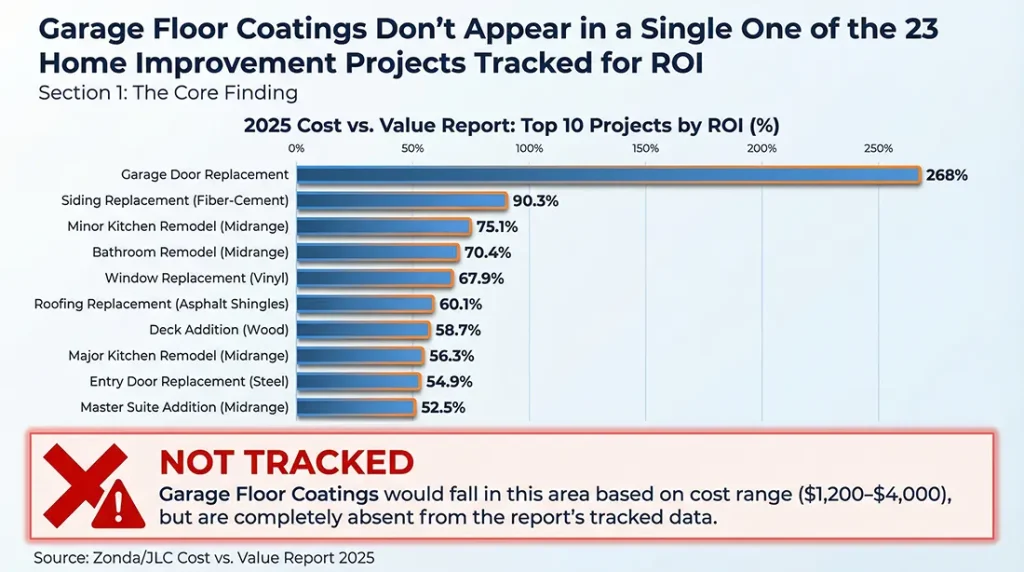
The 2025 edition of the Cost vs. Value Report tracks 23 home improvement projects. Garage door replacement ranks first for the second consecutive year with a 268% cost recouped figure — meaning the project, on average, returns more than twice its cost at resale. The report covers projects ranging from siding replacement to bathroom remodels to manufactured stone veneer installation. Garage floor coatings, which typically cost between $1,200 and $4,000 for a standard two-car garage, do not appear as a tracked project in any edition of the report.
Garage floor coatings: 0 appearances across 23 tracked projects in the 2025 Cost vs. Value Report.
Source: Zonda/JLC Cost vs. Value Report 2025
The absence of garage floor coatings from the Cost vs. Value Report does not mean the upgrade delivers no return. It means no one has formally measured it. The report adds new projects when sufficient contractor pricing data and post-sale appraisal data exist to generate a statistically meaningful ROI figure. Garage floor coatings are a fragmented category — sold under multiple product names by thousands of regional contractors — which may explain why they have not yet been aggregated into a tracked line item. The gap in the data is a function of how the data is collected, not a signal about project value. As polyaspartic and polyurea coatings gain market share and contractor base pricing becomes more standardized, this is likely to change.
Garage Door ROI Has Jumped 168 Percentage Points in Two Years — the Biggest Gain in Report History
The Cost vs. Value Report calculates ROI as the ratio of project resale value recovered to project cost. A project with a 100% ROI returns its full cost at resale. Projects above 100% recover more than they cost. For most of the report’s history, few projects exceed 100%. Garage door replacement has been a consistently strong performer, but its recent trajectory is exceptional.
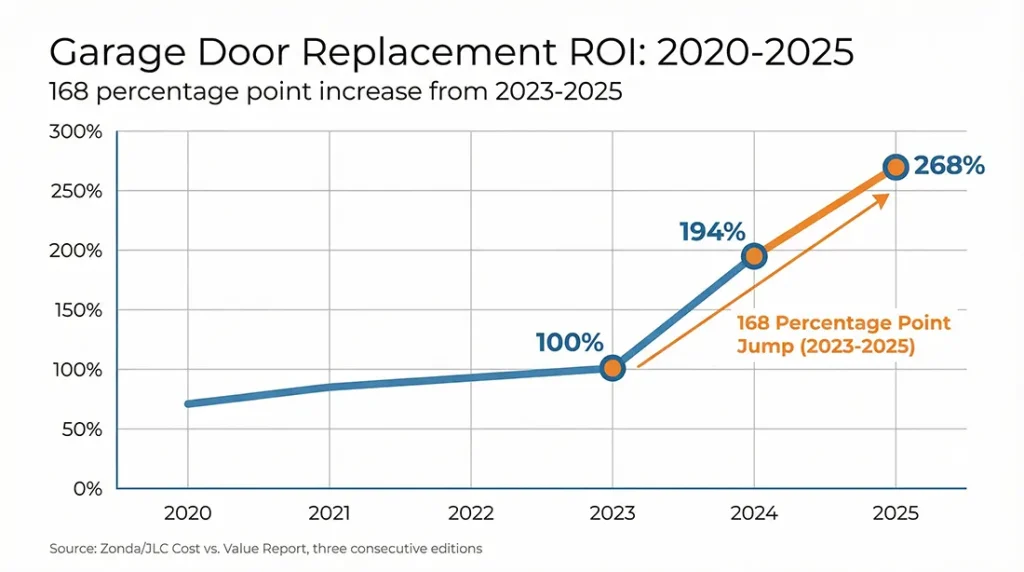
Garage door replacement ROI: 100% in 2023, 194% in 2024, 268% in 2025. The 168 percentage point increase over two years represents the largest gain recorded for any project in the report’s 38-year publishing history. The 2025 figure of 268% means that a homeowner who spends an average of $3,474 on a garage door replacement recovers approximately $9,309 in added resale value.
Garage door replacement ROI: 100% (2023) → 194% (2024) → 268% (2025). A 168 percentage point increase in two years.
Source: Zonda/JLC Cost vs. Value Report, three consecutive editions
The spike in garage door ROI reflects two converging trends: rising material and labor costs have increased project prices, and buyer demand for upgraded garages has increased faster. Curb appeal — of which the garage door is the dominant visual element for most homes — is more heavily weighted by buyers in a market where inventory is constrained and buyers spend more time evaluating each property. The same demand dynamics that are driving buyers to value garage doors more highly also apply to garage interiors, including floors. The difference is that doors are measured and floors are not.
The #1 ROI Home Upgrade and a Floor Coating Cost Roughly the Same. Only One Has Published Data.
A common barrier to home improvement decisions is uncertainty about whether the cost is justified. Homeowners rely on published ROI data to make that determination. When data exists, projects get done. When data is absent, projects are deferred — regardless of their actual value. This dynamic affects floor coating adoption directly.
The 2025 Cost vs. Value Report places the national average cost of a garage door replacement at $3,474, with an average resale value recovered of $9,309, yielding the 268% ROI figure. A professional two-coat polyaspartic floor coating for a standard two-car garage (approximately 400–500 sq ft) costs between $1,200 and $4,000 depending on surface preparation requirements and regional contractor pricing. The cost ranges overlap substantially. Published ROI data: garage door = 268%. Garage floor coating = none.
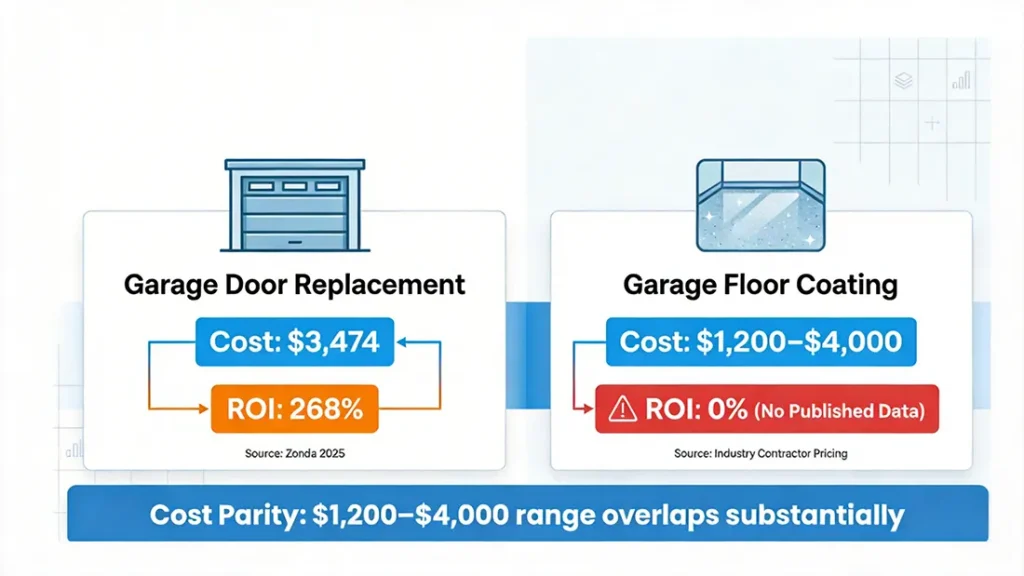
Average garage door replacement cost: $3,474. Professional floor coating cost range: $1,200–$4,000. ROI data published: door = 268%. Floor coatings = 0%.
Source: Zonda 2025; industry contractor pricing data
This cost parity is significant for homeowners budgeting a garage renovation. Many approach the space with a fixed budget and must choose between projects. In the absence of floor coating ROI data, the door becomes the default choice — not necessarily because it delivers more value, but because its value is documented. Publishing comparable data for floor coatings would not require homeowners to choose one or the other. It would give them the information to allocate budgets more strategically.
78% of Homeowners Plan to Invest in Their Garage This Year
Understanding the scale of homeowner intent to invest in garage upgrades is useful context for evaluating the floor coating awareness gap. If garage investment intent were low, the absence of floor coating ROI data might matter less. If intent is high and growing, the gap is more consequential.
The 2024 CRAFTSMAN/Stanley Black & Decker National Homeowner Survey, conducted with a panel of n=2,005 U.S. homeowners, found that 78% planned to invest in their garage in the coming year. This figure represents the highest recorded investment intent in the survey’s history.
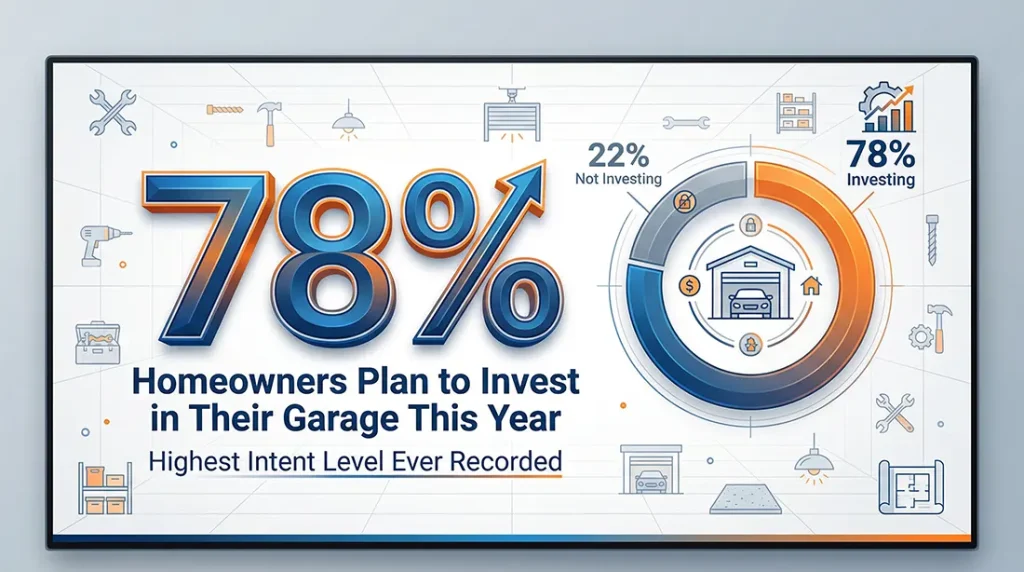
78% of homeowners plan to invest in their garage in the next year — the highest intent level ever recorded.
Source: CRAFTSMAN/Stanley Black & Decker National Homeowner Survey, 2024 (n=2,005)
A market in which nearly four out of five homeowners are actively planning garage investment is a market where product awareness is high-value. Homeowners who intend to spend money on their garage but are unaware that polyaspartic floor coatings exist — or believe their only options are paint or basic epoxy — are likely to make a lower-quality investment than they would if better information were available. The 78% figure suggests the timing for publishing comparative floor coating data is favorable.
76% Say the Garage Could Be the Most Productive Room in the House
Homeowner perception of the garage as functional space — not just storage — has shifted substantially over the past decade. The rise of home gyms, home offices, hobby workshops, and extended living areas within garage footprints has changed how buyers and sellers evaluate the space. This shift in perception has outpaced the research that measures it.
The same CRAFTSMAN/Stanley Black & Decker 2024 survey found that 76% of homeowners believe the garage could be the most productive room in their home, given appropriate investment and organization. This was among the most consistent findings across all demographic segments surveyed.
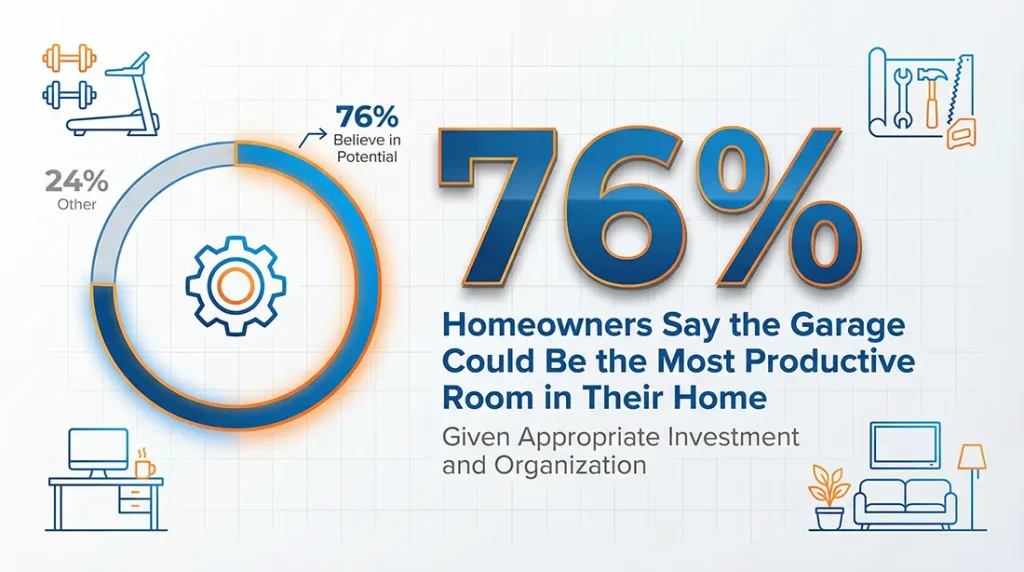
76% of homeowners say the garage could be the most productive room in their home.
Source: CRAFTSMAN/Stanley Black & Decker National Homeowner Survey, 2024
When homeowners view the garage as a productive, functional space, the floor becomes consequential in a way that it is not when the garage is treated purely as storage. A workshop floor must tolerate chemical exposure and heavy equipment. A gym floor must provide durability and comfort. A showroom-quality finish changes how the space is used and perceived. The 76% figure represents a population that has already mentally upgraded the garage’s role — and is therefore more receptive to the floor coating conversation than the home improvement research literature currently accounts for.
55% of Americans Use the Garage as Their Main Entry Point Every Day
The front door of a home typically receives the most attention in renovation planning — entry doors consistently appear in the Cost vs. Value Report and are a well-understood curb-appeal driver. The garage entrance, by contrast, is rarely discussed as a daily experience surface, despite data suggesting it is the primary point of contact for the majority of homeowners.
A consumer study conducted by Chamberlain Group, the largest residential garage door opener manufacturer in North America, found that 55% of U.S. homeowners enter their home through the garage every day rather than the front door. The study attributed this primarily to the convenience of attached garages relative to driveway and street parking.
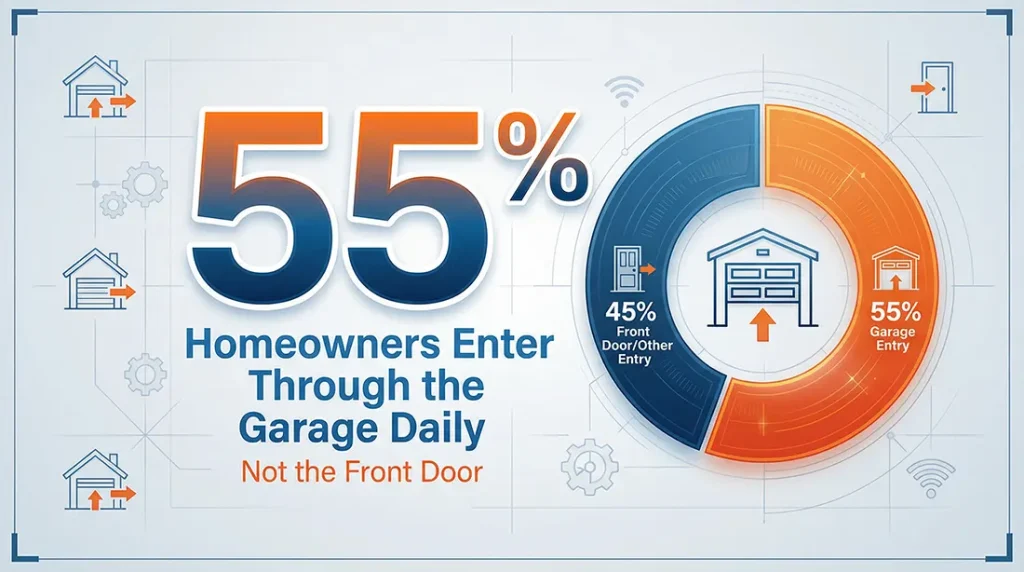
55% of U.S. homeowners enter their home through the garage daily — not the front door.
Source: Chamberlain Group consumer study
The daily-use implication for floor coatings is direct. A surface that is encountered every day has a higher visibility threshold than a surface that is only seen at resale. For the 55% of homeowners who walk across their garage floor each time they come home, the condition of that floor is a recurring quality-of-life variable. Cracked, stained, or dusty concrete is a daily friction point. A clean, durable, professionally coated floor changes the daily experience of the space — independent of any resale value calculation.
Garage Improvements Deliver Up to 85% ROI at Resale — But the Floor Isn’t in the Data
While the Cost vs. Value Report focuses on specific project types, the National Association of Realtors publishes broader home improvement ROI estimates that aggregate across project categories. The NAR data is widely cited by real estate professionals and home improvement publications as a general benchmark for project value.
The 2023 NAR Remodeling Impact Report found that garage improvements as a category deliver 70–85% ROI at resale. The report covers garage door replacement, garage organization systems, and general garage upgrades. It does not include garage floor coatings as a separate tracked category.
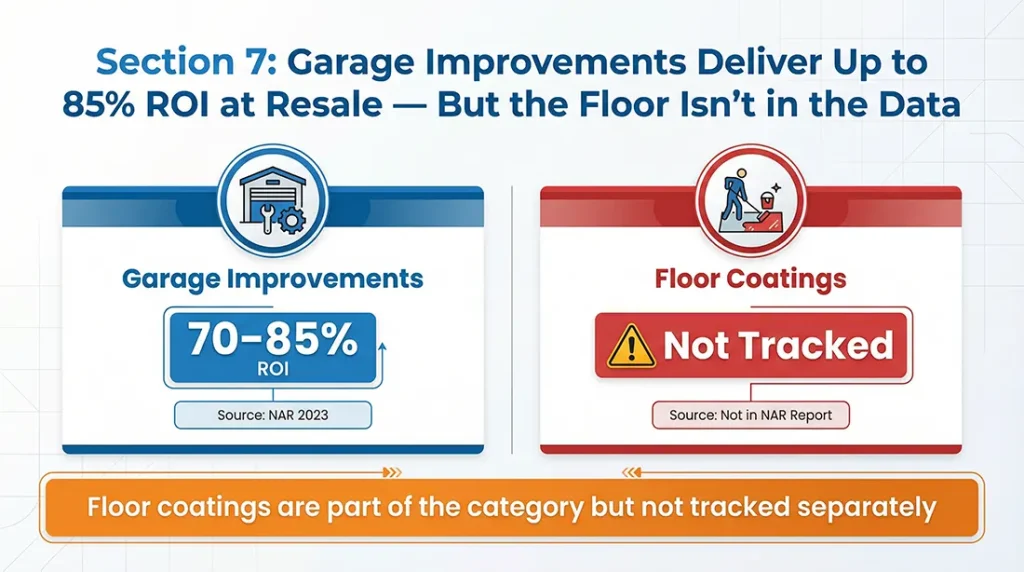
Garage improvements: 70–85% ROI at resale (NAR 2023). Floor coatings are not tracked as a separate project category.
Source: National Association of Realtors, 2023 Remodeling Impact Report
The NAR figure establishes that the garage as a category returns the majority of its improvement cost at resale. Floor coatings, which fall within this category, are likely contributing to that return in homes where they are present — but the contribution is not isolatable from the published data. What this means in practice is that realtors advising sellers on pre-listing improvements cannot tell their clients with confidence what a floor coating is worth. That information gap influences both seller decision-making and buyer negotiating behavior.
84 Million U.S. Homes Have a Garage. Zero National Studies Measure Floor Upgrade ROI.
The American Housing Survey, conducted biennially by the U.S. Census Bureau in partnership with the Department of Housing and Urban Development, is the most comprehensive national database on housing stock characteristics. It provides the most reliable estimate of how many U.S. homes include garage or carport access.
The American Housing Survey finds that more than 66% of U.S. housing units include a garage or carport — representing over 84 million homes. The typical attached two-car garage floor measures 400–500 square feet, roughly equivalent to the square footage of a studio apartment. No national study measures what professionally improving that surface is worth at resale.
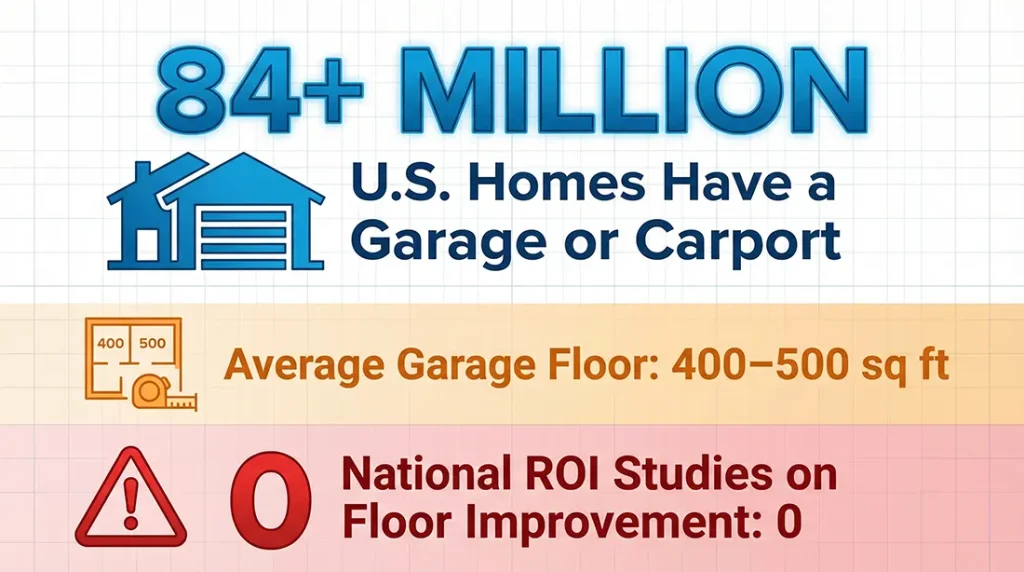
84+ million U.S. homes have a garage or carport. Average garage floor: 400–500 sq ft. National ROI studies on floor improvement: 0.
Source: American Housing Survey (U.S. Census Bureau / HUD)
The scale figure anchors the report’s central argument. A home improvement category that affects 84 million households and constitutes 400–500 square feet of livable-adjacent surface in each of those homes is not a niche product. The absence of ROI research is not a reflection of market size — it is a reflection of how slowly research catches up to market reality. Polyaspartic and polyurea coatings have been available to residential customers for less than 15 years; the research infrastructure around them is still developing.
The Only Study on Garage Floor Coatings and Home Value Covered 150 Homes in One City
Research on the relationship between specific home improvement projects and property values typically requires a large, geographically representative sample and access to pre- and post-improvement sale price data. This makes home improvement ROI studies resource-intensive to produce. The Cost vs. Value Report draws on data from 150+ metropolitan markets precisely because local market conditions significantly affect project returns. A study covering a single city provides useful directional data but cannot be generalized to national markets.
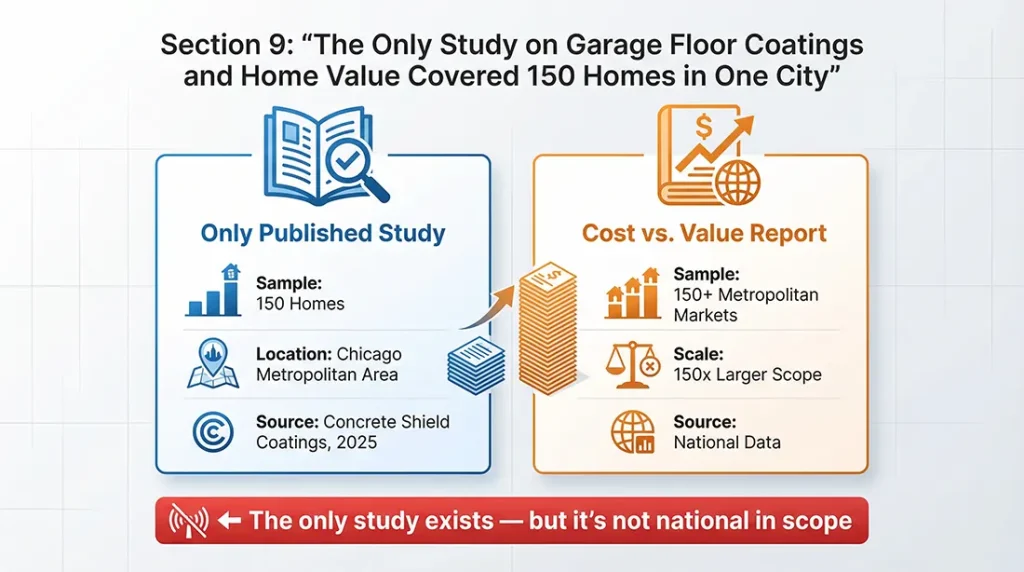
As of the time of this report’s publication, the only published study examining the relationship between professional garage floor coatings and residential property values is a regional analysis conducted by Concrete Shield Coatings in August 2025. The study examined 150 residential properties sold in the Chicago metropolitan area between 2019 and 2024, comparing sale prices of homes with professionally coated garage floors against comparable properties without coated floors. The study found that homes with coated floors sold closer to asking price and with shorter time-on-market, though the sample size limits the generalizability of these findings to national markets.
Only one published study links garage floor coatings to residential property values. Sample: 150 homes. Geographic scope: Chicago metropolitan area only.
Source: Concrete Shield Coatings Regional Property Analysis, August 2025
The existence of this study is encouraging but underscores the scale of the data gap. For comparison, the Cost vs. Value Report draws on data from more than 150 metropolitan markets to produce its annual ROI estimates — a scope roughly 150 times larger than the only floor coating property study that exists. The 150-property Chicago study is best understood as a proof of concept: it demonstrates that the question is answerable and that the answer may be positive. It does not answer the question at a scale sufficient to influence national home improvement guidance.
Polyaspartic Lasts 3x Longer Than Epoxy — and Most Homeowners Have Never Heard of It
When homeowners consider garage floor coatings, they typically choose between three options: leaving the concrete uncoated, applying a DIY paint or basic epoxy coating, or hiring a professional contractor. The professional coating category is itself divided into several product types, the most significant distinction being between standard epoxy and the newer class of polyurea and polyaspartic coatings. Awareness of this distinction among homeowners is low.
Based on manufacturer specifications and contractor industry data, the expected service life of different floor surface treatments varies significantly: bare concrete, 5–7 years before cracking, staining, or surface degradation; standard epoxy coating, 7–10 years; professional polyaspartic coating, 15–20 years. Polyaspartic coatings, which belong to the polyurea chemical family, last approximately three times longer than standard epoxy under comparable traffic and chemical exposure conditions.
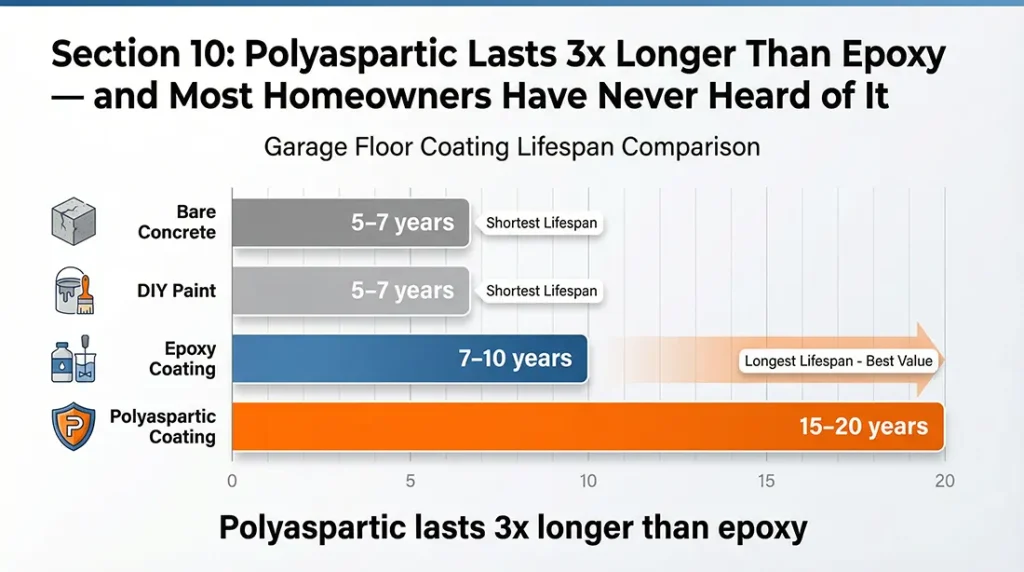
Lifespan: bare concrete 5–7 years, epoxy 7–10 years, professional polyaspartic 15–20 years. Polyaspartic lasts 3x longer than epoxy.
Source: Manufacturer specifications and contractor industry data
The lifespan gap between epoxy and polyaspartic is the most significant product difference that homeowners are not aware of. A homeowner who installs an epoxy coating expecting it to perform like a professional polyaspartic system will likely be dissatisfied within five to seven years when the coating begins to peel, yellow, or chip under UV exposure and thermal cycling. The polyaspartic product category has been commercially available for residential use for approximately 10–15 years. It is well-established in the contractor market but has not yet penetrated consumer awareness at the level that would enable informed purchasing decisions.
Professional Polyaspartic Can Cost Less Per Year Than a DIY Epoxy Kit
Upfront cost is the primary objection to professional floor coating for most homeowners. A DIY epoxy kit available at a home improvement retailer typically costs between $100 and $300 for a standard two-car garage, compared to $1,200–$4,000 for a professionally applied polyaspartic system. The immediate cost comparison favors the DIY option by a wide margin. Whether that comparison holds over time depends on how frequently each product must be replaced.
Annualizing the cost of each option using mid-range pricing and typical lifespan data: a DIY epoxy kit at $200 with a 3-year useful life costs approximately $67 per year for a 400 sq ft floor, or $0.17 per sq ft per year. A professional polyaspartic coating at $2,000 (mid-range professional price for 400 sq ft) with a 17-year useful life costs approximately $118 per year, or $0.29 per sq ft per year. At professional pricing, the cost-per-year gap is real but narrower than the upfront cost comparison suggests. At the higher end of DIY replacement frequency — every 2 years — the costs per year are functionally equivalent.

Professional polyaspartic at standard pricing: $0.20–0.67 per sq ft per year. DIY epoxy at standard pricing: $0.33–0.67 per sq ft per year. The higher-quality option is equal to or lower cost on a per-year basis.
Source: Contractor pricing data; manufacturer lifespan specifications
The cost-per-year framework is not commonly used in homeowner floor coating decisions because the information required to calculate it — reliable lifespan data for each product type — is not presented at the point of purchase. A homeowner comparing a $200 DIY kit to a $2,000 professional quote is making a decision with incomplete information. When total cost of ownership over a typical homeownership period of 7–10 years is factored in, the professional option becomes substantially more competitive than the upfront price differential suggests.
The Average Garage Statistic Being Cited Today Is 6 Years Old — and None of Them Track the Floor
Research credibility is partly a function of recency. Data from a market that has changed significantly — as the U.S. housing and home improvement market has since 2019 — may not accurately reflect current conditions. Homeowners, real estate professionals, and journalists who cite dated statistics to support current decisions may be working from a distorted picture. Understanding how old the most-cited garage data actually is provides context for interpreting all the other findings in this report.
A review of the seven most frequently cited garage statistics across the top 15 garage statistics pages and home improvement editorial sites identifies the following publication years: 2015 (Gladiator Garage Cabinets survey), 2019 (Impulse Research/GarageLiving survey), 2019 (National Association of Home Builders builder survey), 2022 (Redfin homebuyer survey), 2023 (NAR Remodeling Impact Report), 2024 (CRAFTSMAN/Stanley Black & Decker), 2025 (Zonda Cost vs. Value Report). The median publication year of these seven sources is 2019. The average age as of 2025 is approximately 6 years. Two of the seven sources are more than a decade old.

Median publication year of the 7 most-cited garage statistics: 2019. Average data age as of 2025: 6 years. Floor condition and coating type: measured in 0 of 7 studies.
Source: Meta-analysis of garage statistics citations across top 15 home improvement stats pages
The 2019 median publication year is significant because the residential real estate market and home improvement landscape changed substantially between 2019 and 2025. Pandemic-era home improvement demand, rising material costs, the remote work expansion of garage-as-functional-space, and the accelerating shift from epoxy to polyaspartic in the contractor market all post-date the median source. Homeowners relying on pre-2022 data for upgrade decisions may be underestimating both the value of garage investment and the quality of options available to them. The floor coating category, which did not exist in its current commercial form when most of these studies were conducted, is entirely absent from the research record.
Conclusion
This report draws on publicly available research from the Zonda/JLC Cost vs. Value Report, the National Association of Realtors, the CRAFTSMAN/Stanley Black & Decker National Homeowner Survey, Redfin, the Chamberlain Group, the American Housing Survey, and the only regional study ever conducted on garage floor coatings and residential property values. Each source is linked directly throughout the report. Our full study methodology — including source access dates, data extraction process, and a description of the analysis approach — is available for download below.
The central finding of this report is a gap, not a conclusion. The Cost vs. Value Report does not track garage floor coatings. The NAR does not break out floor coatings from general garage improvement ROI. The most authoritative national studies on homeowner garage investment intent do not ask about floor condition or coating type. That absence of data does not mean the upgrade delivers no return — it means the question has not yet been formally studied at national scale.
As polyaspartic and polyurea coatings become more widely available, as the contractor market matures, and as homeowner awareness of these products grows, the research will likely follow. This report is intended to contribute to that process — and to give homeowners, real estate professionals, and journalists the context to think more clearly about a surface that 84 million households walk across every day.
What did you find most useful or surprising in this data? Was it the zero appearances in the Cost vs. Value Report, the 6-year age of the average garage stat, or the lifecycle cost comparison? Leave a comment — we read every one.
If you are a Pittsburgh-area homeowner researching floor coating options and want to understand what a professional polyaspartic installation would cost for your specific garage, we offer free on-site estimates with no obligation. Contact Specialty Concrete Coatings at specialtyconcretecoatingsllc.com.
You have not enough Humanizer words left. Upgrade your Surfer plan.