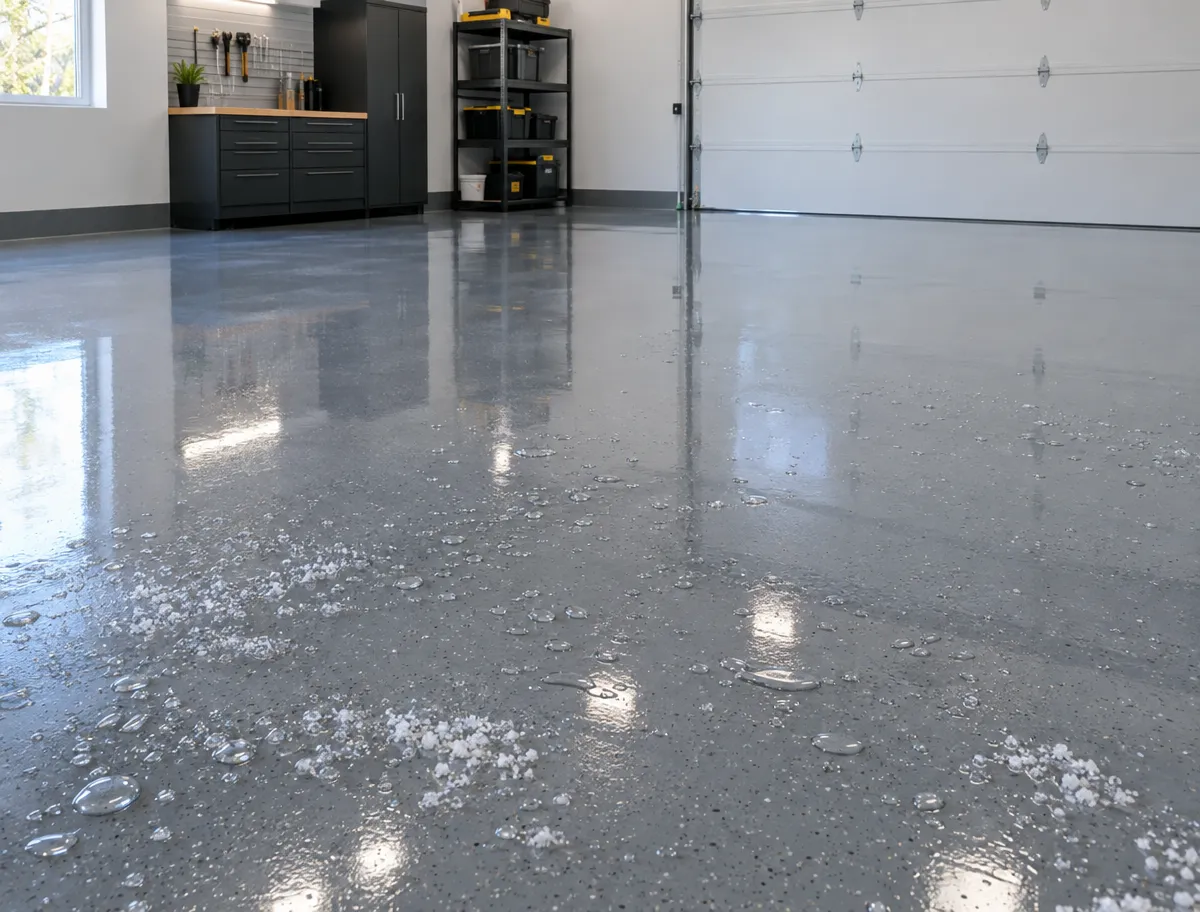
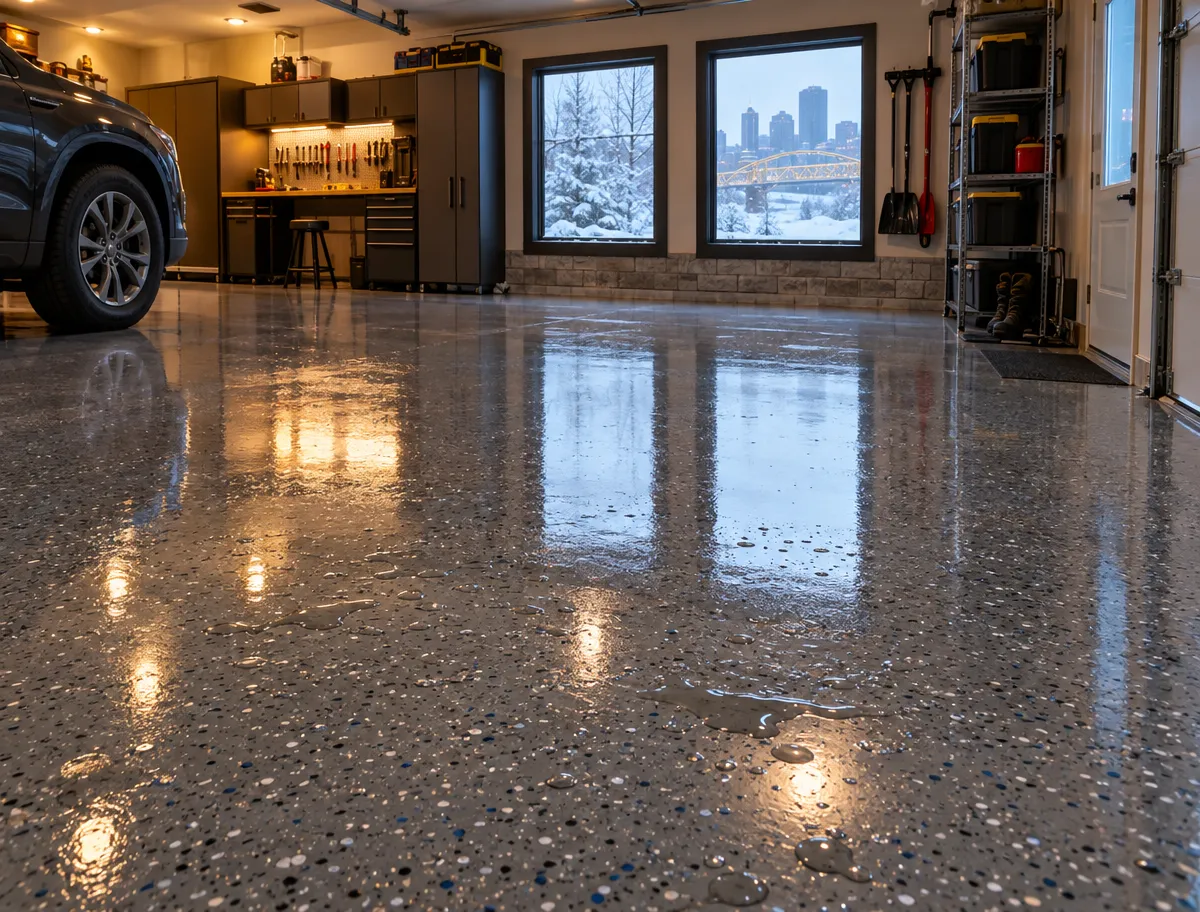
Quick answer: 100% solids epoxy and water-based epoxy are both epoxy, but they cure into very different floors. “100% solids” means the entire product becomes the coating, so it goes on thick and hardens into a tough, long-lasting floor that shrugs off hot tires, oil, and heavy use — which is why it’s the go-to for garages. Water-based epoxy is thinner, easier to apply, lower in odor, and cheaper, but it doesn’t last as long or resist hot-tire pickup as well. For a working garage, 100% solids almost always wins.
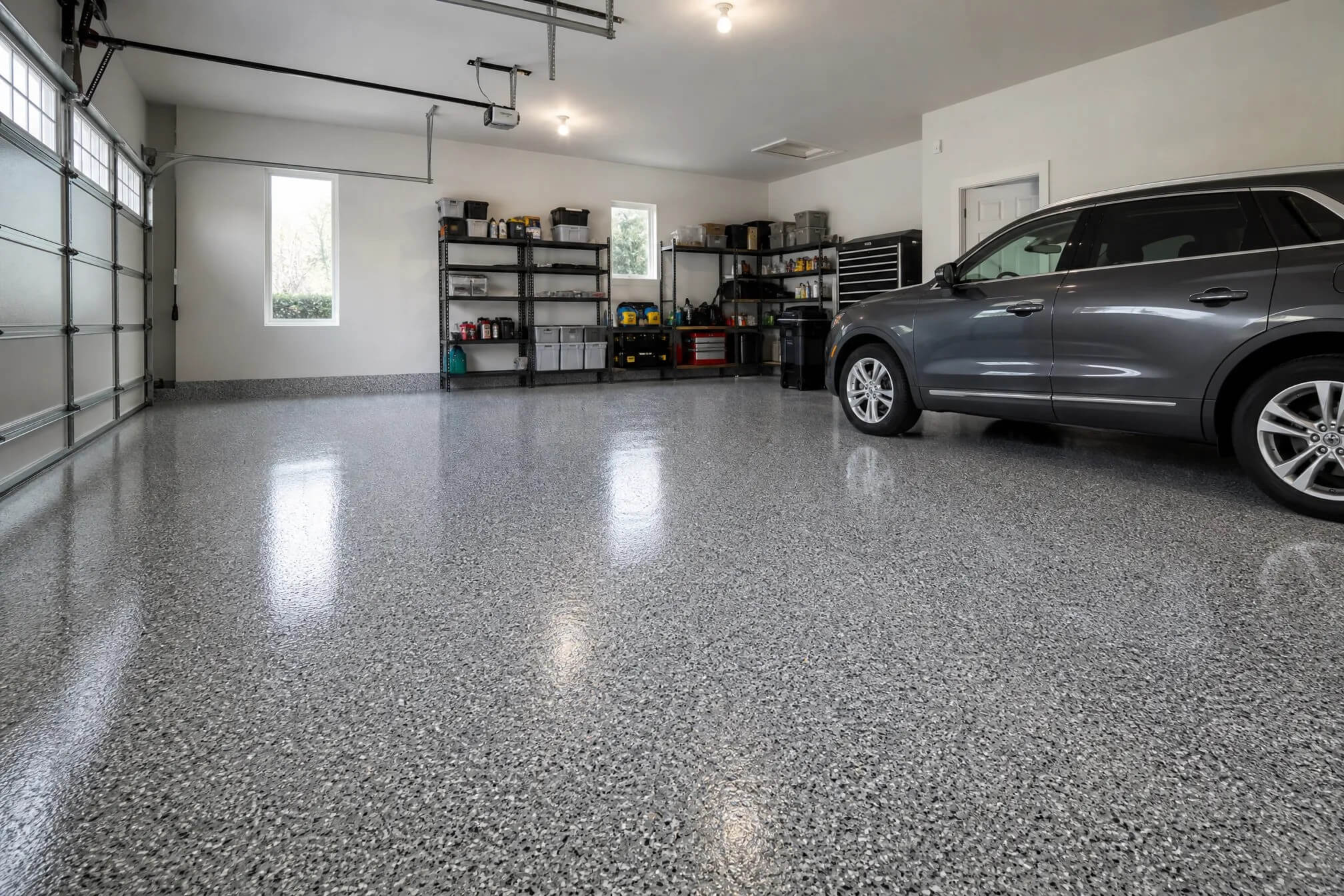
If you’ve shopped around for a garage floor, you’ve probably seen wildly different prices for what all gets called “epoxy.” A big-box kit might run a hundred dollars, while a professional epoxy floor coating costs more — and the difference usually comes down to one thing most homeowners have never heard of: solids content.
Understanding 100% solids epoxy versus water-based epoxy is the single best way to predict how a garage floor will look and hold up years down the road. This guide explains what “solids” means, how the two types differ, and which one actually makes sense for your garage — in plain English.
Key Takeaways
- “Solids” is the percentage of the product that stays behind as coating after it cures.
- 100% solids epoxy goes on thick, cures hard, and resists hot tires, oil, and heavy wear.
- Water-based epoxy is thinner, lower-odor, cheaper, and easier to apply — but less durable.
- For garages with vehicles, 100% solids is the more reliable, longer-lasting choice.
- No matter the type, surface prep is what makes or breaks how long the floor lasts.
First, What Does “Solids” Mean in Epoxy?
Every epoxy coating is a mix of two parts: the “solids” that stay behind to form the hard floor, and a carrier that helps it spread and then leaves. The solids percentage tells you how much of what’s in the bucket actually becomes your finished coating.
Think of it like paint. A high-solids product leaves a thick, substantial film; a low-solids product leaves a thin one once the carrier evaporates. With epoxy, that single number drives almost everything that matters: thickness, durability, and how well the floor stands up to a car.
What Is 100% Solids Epoxy?
100% solids epoxy is exactly what it sounds like: the entire product becomes the coating. Nothing evaporates, so what you trowel or squeegee on is what cures on the floor. That gives it some big advantages:
- Thick, high-build film: a single coat lays down many times thicker than water-based, creating a substantial, protective layer.
- Outstanding durability: it resists abrasion, impact, oil, and chemicals — built for real wear.
- Hot-tire resistance: it holds up to the hot tires that lift and peel weaker coatings.
- Long service life: a properly installed 100% solids floor lasts for many years.
The trade-offs: it cures fast and is less forgiving to apply, so it’s best installed by professionals, and it costs more up front than a DIY kit. For a garage that sees vehicles and traffic, that cost usually pays for itself in longevity.
What Is Water-Based Epoxy?
Water-based epoxy is epoxy that’s been thinned with water. As it cures, the water evaporates and leaves behind a thinner epoxy film. Because that carrier is water rather than a harsh solvent, it has lower VOCs (volatile organic compounds) and less odor during application — a real plus in an enclosed garage. Its strengths:
- Easy, forgiving application: it rolls on much like paint, which is why most DIY kits are water-based.
- Low odor: comfortable to apply in a closed space with less fumes.
- Lower cost: cheaper up front than a professional high-solids system.
- Breathable: it tolerates a little slab moisture better than some thicker coatings.
The catch is in the name: thinner. Because so much of it evaporates, a water-based coat is a fraction of the thickness of 100% solids, which means less durability, weaker hot-tire and chemical resistance, and a shorter lifespan — especially under vehicles.
100% Solids vs. Water-Based: Side by Side
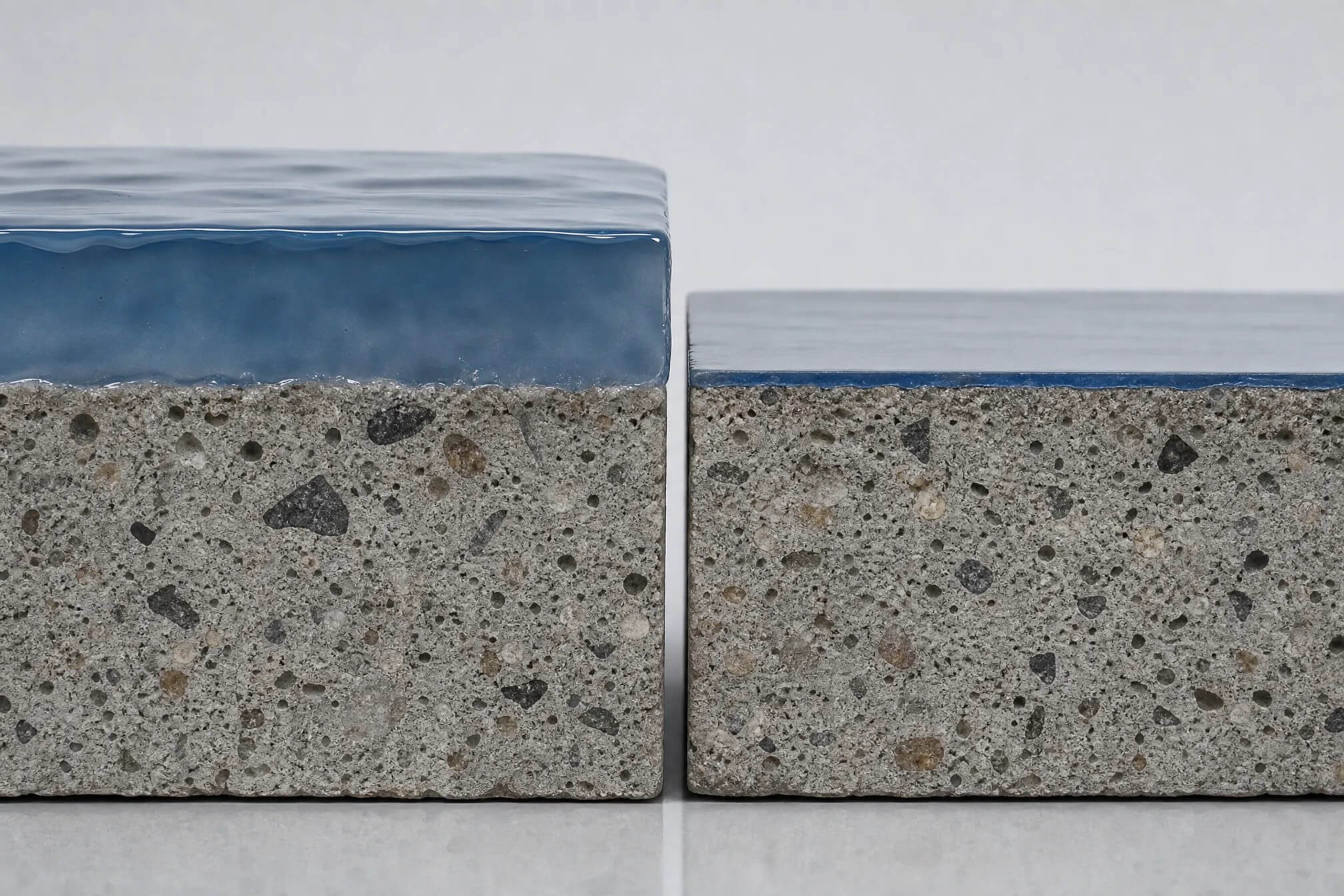
Here’s how the two stack up on the factors that matter most for a garage:
| Factor | 100% Solids Epoxy | Water-Based Epoxy |
| What it is | All product becomes coating | Epoxy thinned with water |
| Solids content | ~100% | Roughly 40–60% |
| Film thickness | Thick (high-build) | Thin |
| Durability | Very high | Moderate |
| Hot-tire resistance | Excellent | Limited |
| Oil & chemical resistance | Excellent | Moderate |
| Odor / VOCs | Low | Low, water-thinned |
| Application | Professional, cures fast | Easy, DIY-friendly |
| Cost | Higher up front | Lower up front |
| Best for | Garages, high-traffic, commercial | Low-traffic, budget, DIY |
Why the Difference Matters for a Garage
A garage is one of the toughest environments in your home, and it’s exactly where thin coatings fail. Here’s what your floor is up against:
- Hot-tire pickup: warm tires from driving grip the floor as they cool and can pull a thin or poorly bonded coating right off the slab. A thick 100% solids floor resists this; thin coatings often don’t.
- Oil, gas, and chemicals: drips and spills are constant in a garage, and high-solids epoxy shrugs them off far better.
- Weight and abrasion: vehicle weight, dropped tools, jacks, and foot traffic wear a thin film quickly.
This is why, for a garage floor coating that has to live with cars, the extra thickness and toughness of 100% solids epoxy pays off. The same logic applies to commercial concrete coatings, where floors take even heavier abuse.
Which Should You Choose?
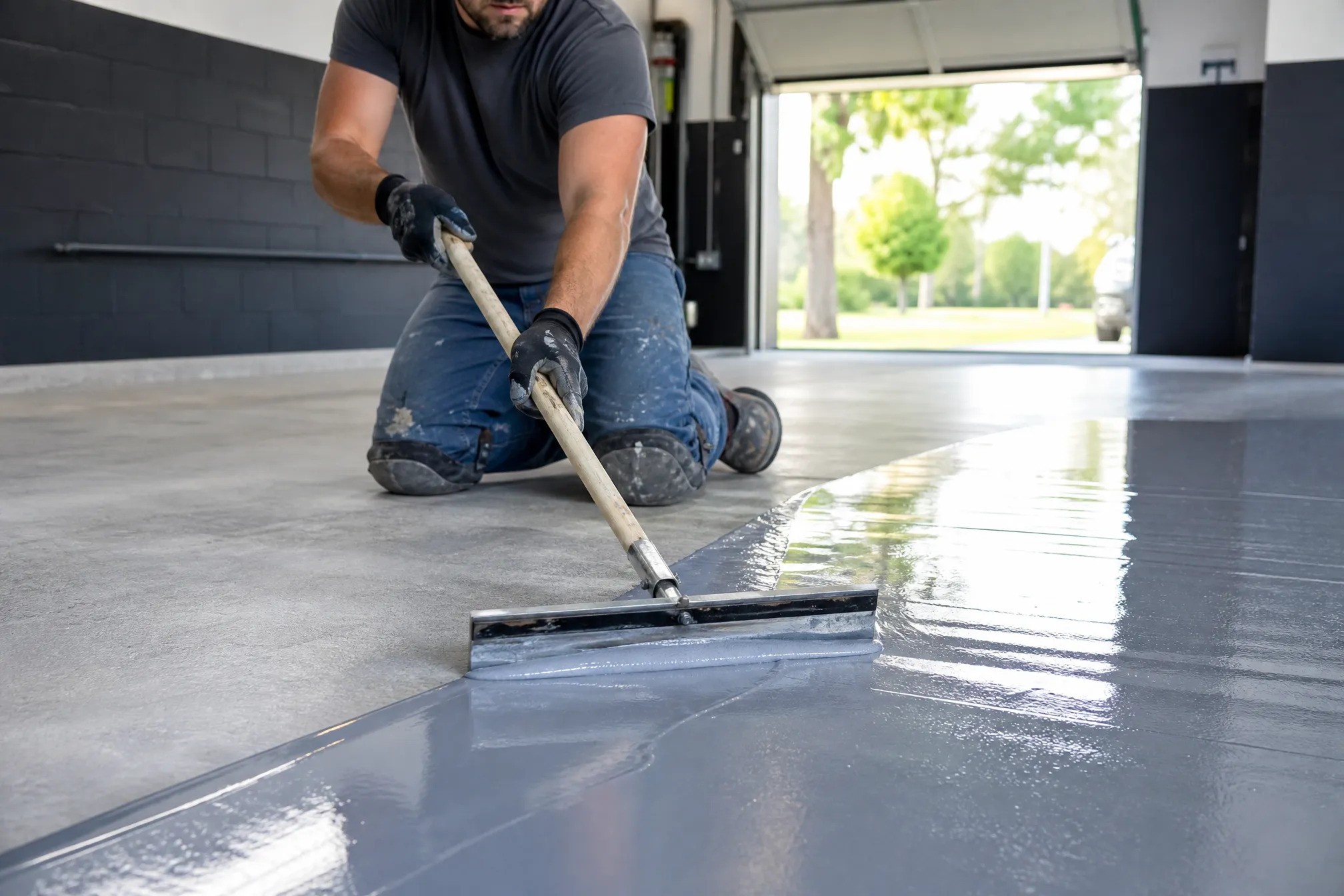
The right choice comes down to how you use the space and what you expect from it:
- Choose 100% solids if: you park vehicles in the garage, want maximum durability, and want a floor that lasts for years with minimal worry.
- Water-based can work if: it’s a low-traffic space, you’re on a tight budget, or you’re doing a quick DIY refresh and accept a shorter lifespan.
Pro insight: The biggest secret in this whole debate? Surface prep matters more than the product. Even the best 100% solids epoxy will peel if it’s rolled onto a slick, unprepared slab — and the most common reason garage floors fail is skipped prep, not the wrong epoxy. A professional grinds the concrete first so the coating bonds for good. Get the prep right, choose the right solids for the job, and you’ll only do this once.
100% Solids vs. Water-Based, at a Glance
- “Solids” = how much of the product stays as coating; higher solids means a thicker floor.
- 100% solids: thick, tough, hot-tire and chemical resistant — the garage standard.
- Water-based: thinner, low-odor, cheaper, DIY-friendly — best for light-duty spaces.
- Surface prep makes or breaks every epoxy floor, regardless of type.
- Want the right floor the first time? Call Specialty Concrete Coatings at (724) 815-1977 for a free consultation.
Frequently Asked Questions
What does 100% solids epoxy mean?
It means 100% of the product becomes the coating — nothing evaporates during curing, so it goes on thick and cures into a high-build, durable floor. Water-based and solvent-based epoxies contain carriers that evaporate, leaving a thinner film.
Is 100% solids epoxy better than water-based for a garage?
For most garages, yes. It’s thicker, more durable, and far more resistant to hot-tire pickup, oil, and chemicals. Water-based epoxy is better suited to low-traffic spaces, tight budgets, or DIY projects.
Can I use water-based epoxy in my garage?
You can, and it’ll improve the look, but set expectations. It’s thinner and less durable, so under vehicles it’s more prone to hot-tire pickup, wear, and peeling over time than a 100% solids system.
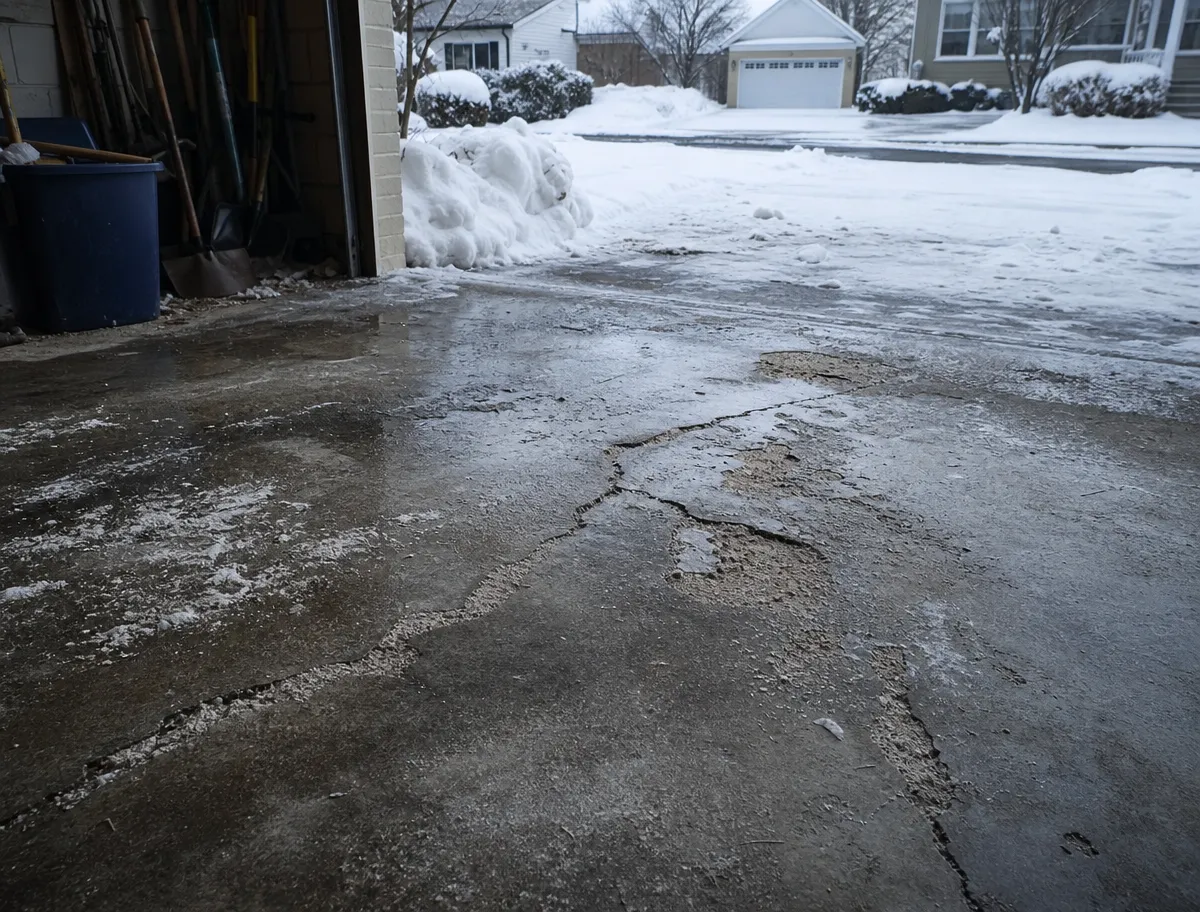
Why do garage epoxy floors peel or lift?
The two biggest reasons are poor surface prep and a coating that’s too thin. Hot tires can grip and lift a thin or poorly bonded film, which is why professional grinding and a thicker, high-solids epoxy matter so much.
Are DIY epoxy kits 100% solids or water-based?
Most big-box, roll-on kits are water-based or low-solids. They’re affordable and easy to apply, but they go on thin and generally won’t last as long as a professionally installed 100% solids system, especially under vehicles.
Related Guides
- Epoxy Floor Coatings in Pittsburgh & NW Pennsylvania
- Garage Floor Coatings
- Garage Concrete Coating Options
- Commercial Concrete Coatings
The Bottom Line
“Epoxy” isn’t one product — it’s a category, and the solids content is what separates a floor that lasts a decade-plus from one that starts lifting in a year. For a garage that has to handle cars, hot tires, and spills, 100% solids epoxy is almost always the smarter investment. Water-based has its place in lighter-duty spaces and DIY budgets, but it’s not built for the same punishment.
Not sure which is right for your floor? The team at Specialty Concrete Coatings has spent 15+ years coating garages across Pittsburgh and NW Pennsylvania — reach out for a free consultation and an honest recommendation for your space.
About Specialty Concrete Coatings: Specialty Concrete Coatings is a full-service epoxy and concrete coating contractor based in New Castle, PA, serving Pittsburgh and Northwest Pennsylvania for 15+ years. Our 5-star rated, fully insured team installs durable garage, basement, and commercial floor coatings — from solid-color and metallic epoxy to quartz finishes. Call (724) 815-1977 for a free consultation and let us help you choose the right floor for your space.