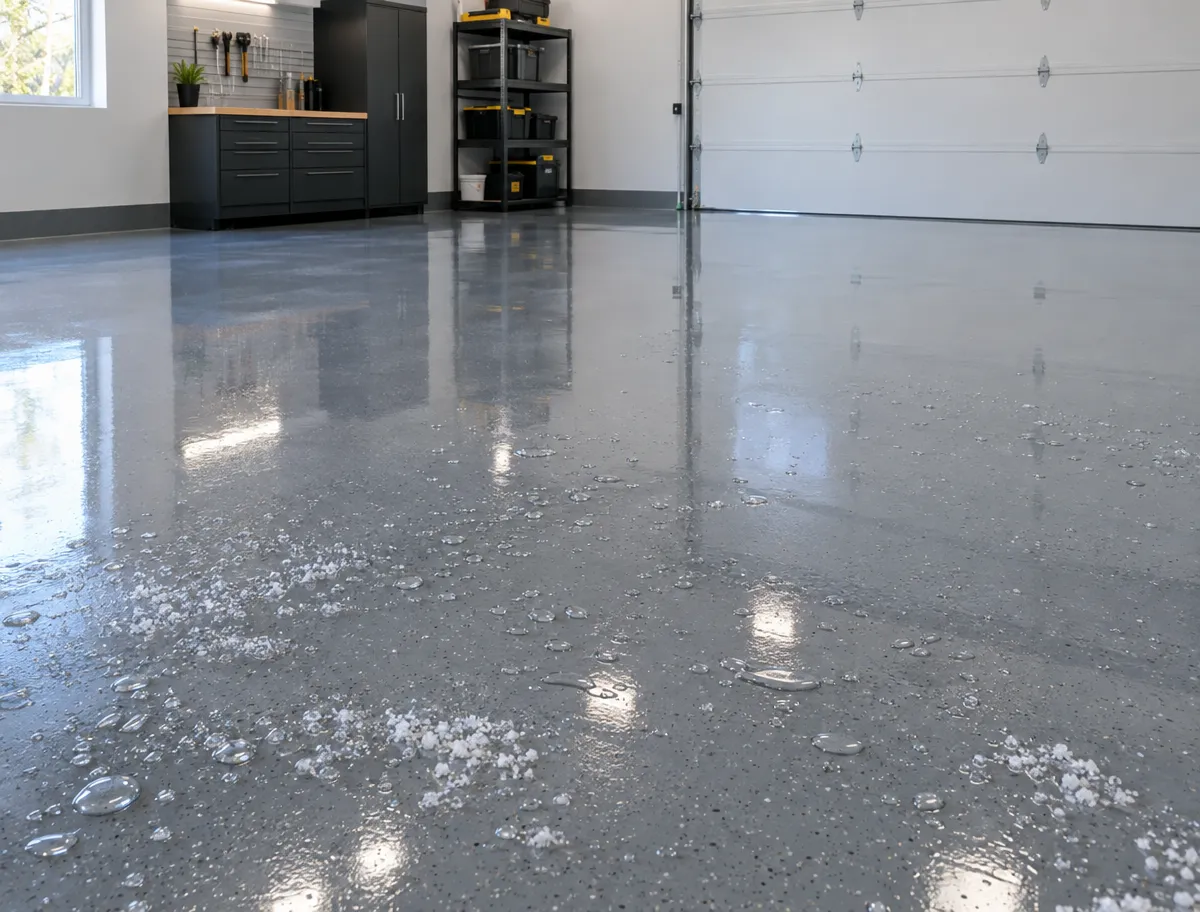
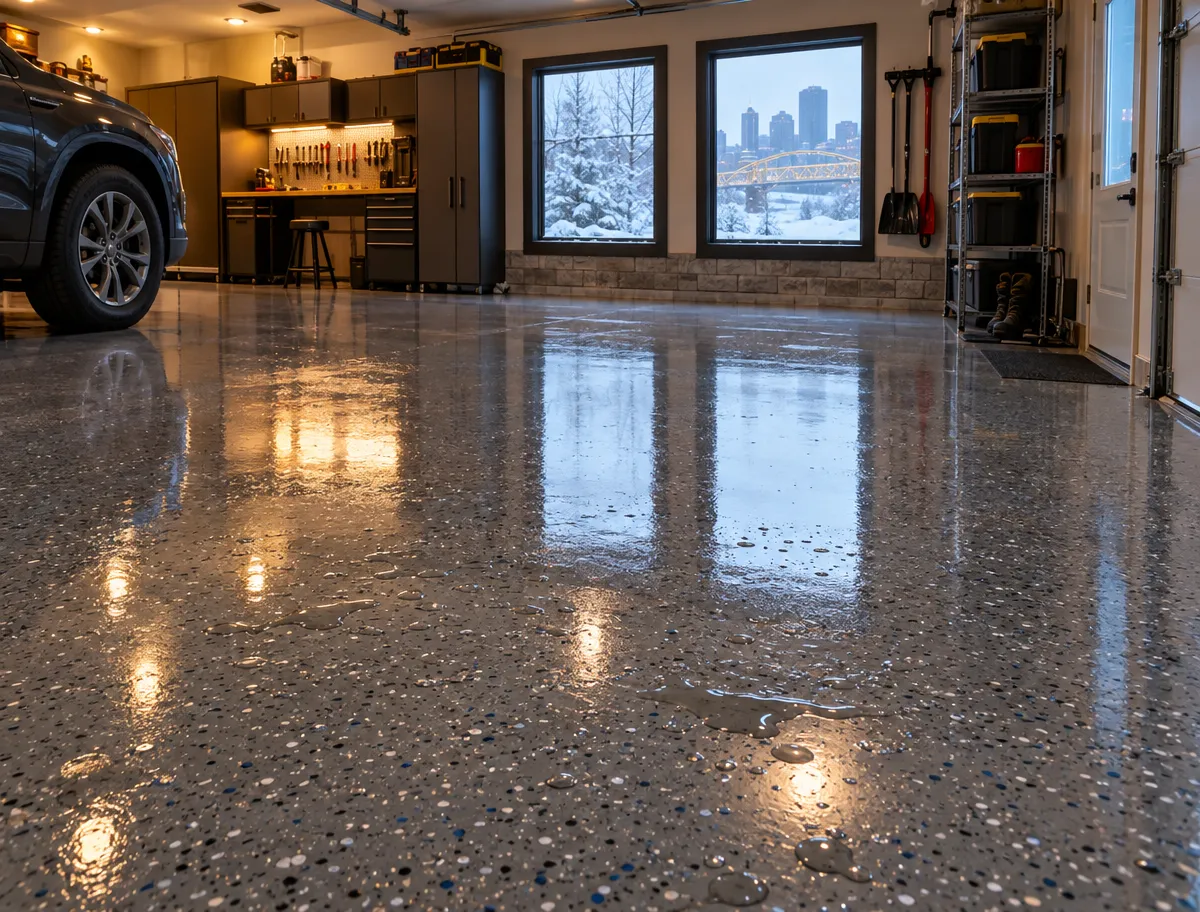
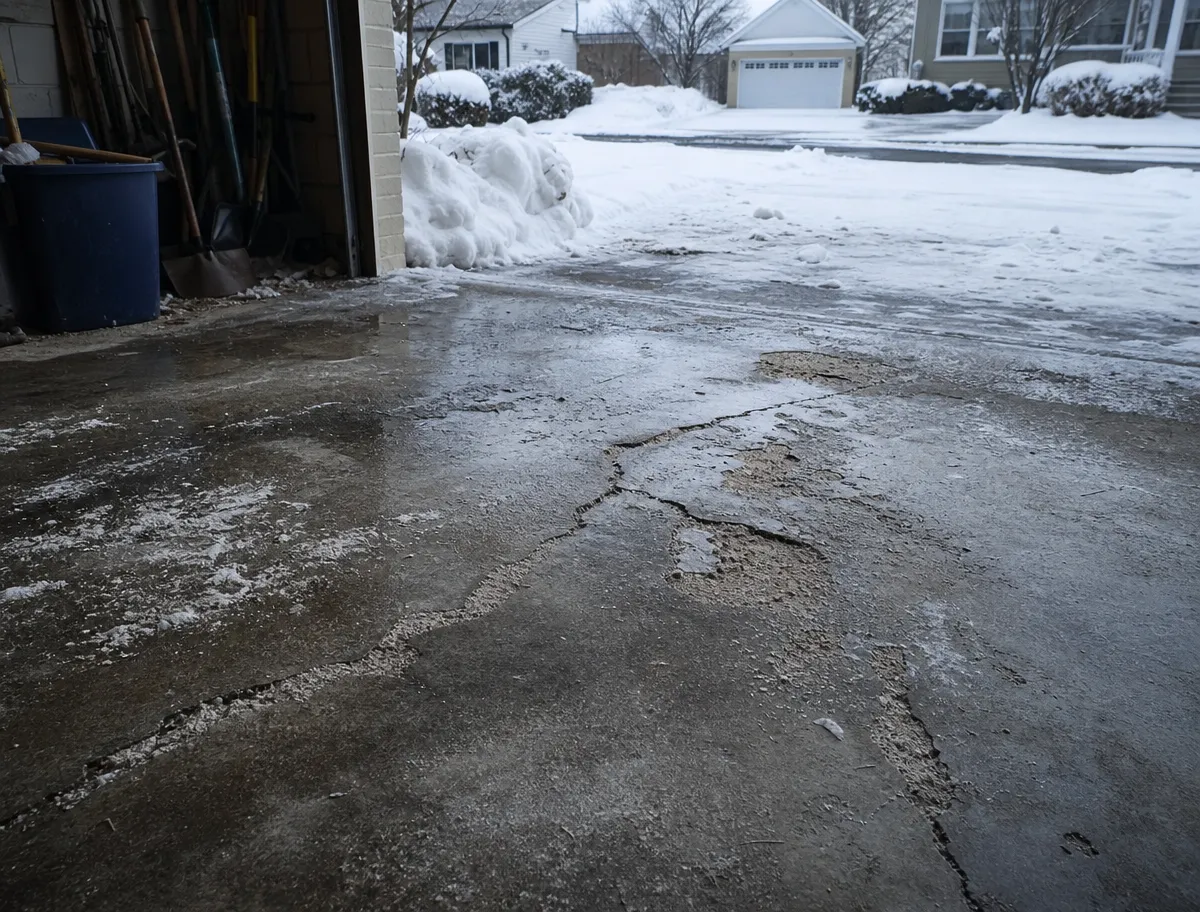
Quick Answer: For Pittsburgh basements, a polyurea base coat with a polyaspartic topcoat outperforms standard epoxy by a significant margin. Pittsburgh’s 84% winter humidity, clay-heavy Allegheny County soils, and freeze-thaw temperature swings create moisture vapor pressure that separates standard epoxy from below and thermal cycling that cracks it at the joints. Polyurea is 6X stronger than epoxy, flexible, and moisture-resistant. The polyaspartic topcoat adds UV stability and abrasion resistance. Most Pittsburgh professional polyurea/polyaspartic systems last 10 to 20 years; most standard epoxy installs in Western PA show failure signs within 3 to 5 years.
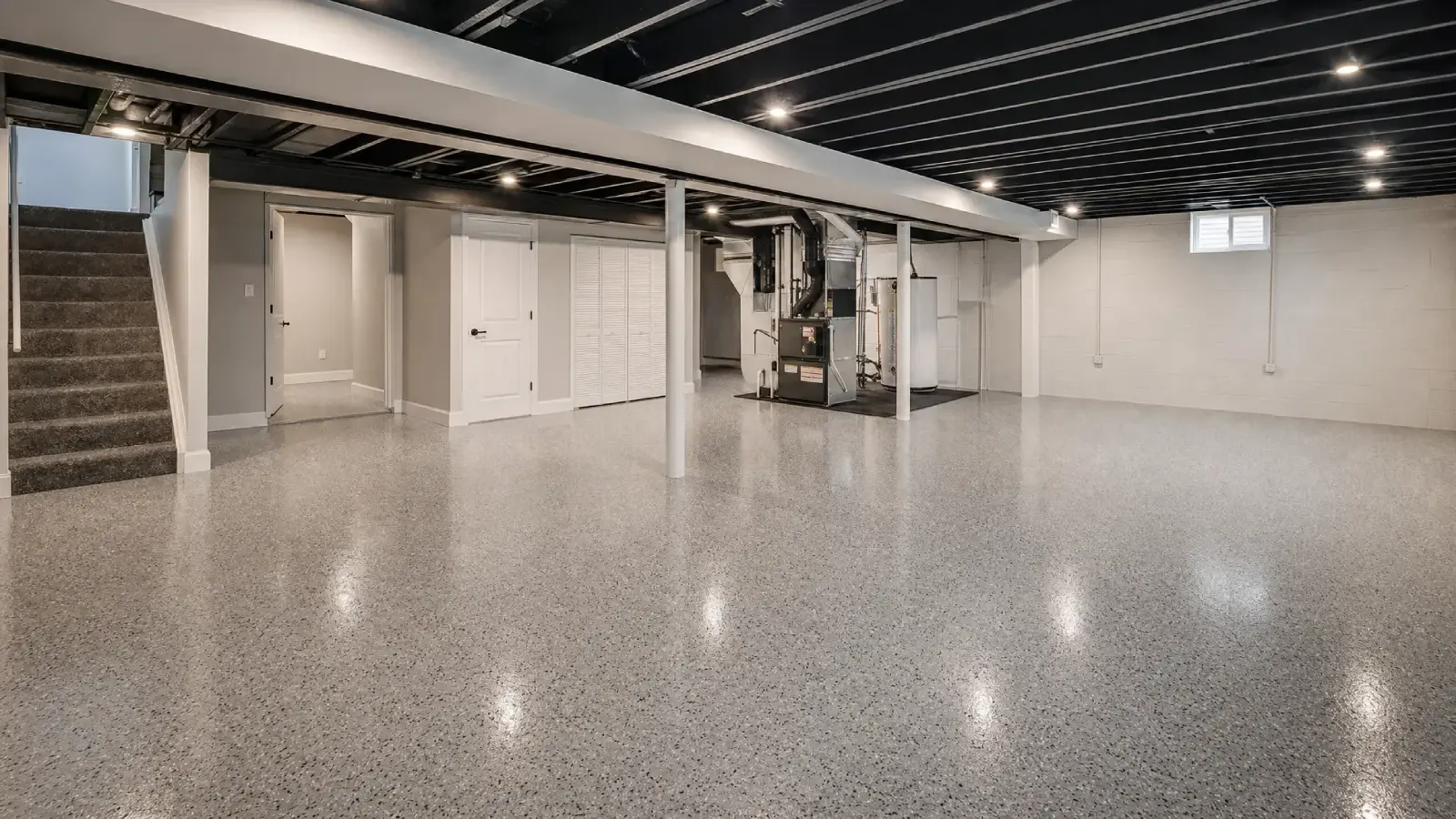
Pittsburgh homeowners looking at basement floor coating options will encounter three primary systems: standard epoxy, polyurea (which installers often call “polyurea/polyaspartic”), and polyaspartic-only systems. They’ll also encounter significant marketing confusion about what each product actually is, how it performs, and why the price difference between a $3,000 epoxy install and an $8,000 polyurea install exists.
The honest answer is that in Western PA’s specific climate conditions, the performance difference is real and significant. Pittsburgh’s combination of high humidity, clay-heavy soils, and freeze-thaw cycles creates three distinct failure mechanisms for basement coatings. Standard epoxy typically encounters at least two of the three. Polyurea/polyaspartic systems, professionally installed with diamond grinding and moisture testing, handle all three.
Specialty Concrete Coatings has installed basement floor coatings throughout Pittsburgh, Allegheny County, and Western PA. This guide breaks down each option honestly — what it is, how it performs in Pittsburgh’s conditions, what it costs, and which Pittsburgh basements it’s right for — so you can make an informed decision before calling anyone for an estimate.
What Makes Pittsburgh Basements Different From a Coating Perspective?
Three conditions make Pittsburgh basements uniquely challenging for floor coatings:
Moisture vapor from clay-heavy soils
Western PA’s soils are clay-heavy, and clay holds and transmits moisture. Allegheny County’s annual precipitation averages 38 to 40 inches, spread across the year — unlike drier climates where seasonal dry periods allow soil moisture to normalize. This means Pittsburgh basement slabs are under near-continuous moisture vapor pressure from below, with the moisture migrating upward through the porous concrete matrix. Pittsburgh’s winter humidity averages 84%, adding ambient moisture pressure from above.
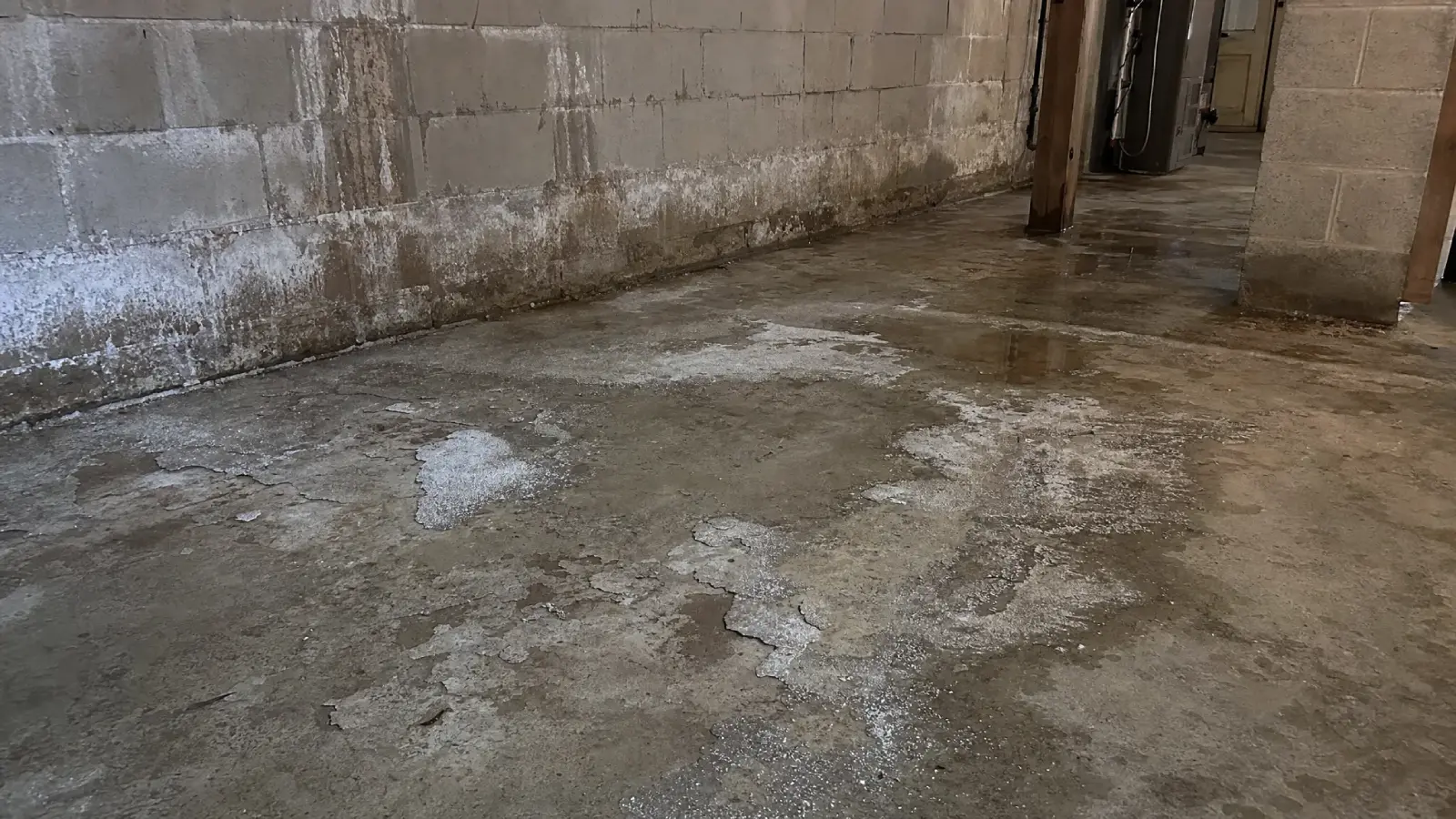
A coating applied to a Pittsburgh basement without a moisture vapor barrier traps that rising vapor under the coating. The pressure builds until the coating blisters, bubbles, and separates from the concrete — a failure mode that is so common in Pittsburgh that experienced local contractors build moisture assessment into every estimate as a mandatory first step.
Freeze-thaw concrete movement
Pittsburgh’s winter temperatures oscillate between the 20s and 40s Fahrenheit repeatedly through November, December, January, February, and March — creating dozens of freeze-thaw cycles per season. The concrete slab expands and contracts with each cycle. Standard epoxy, being a rigid thermosetting resin, cannot flex with that movement. Stress accumulates at control joints, expansion joints, and the perimeter of the slab where thermal movement is greatest. The result is cracking and delamination starting at exactly those points — typically visible within 2 to 3 Pittsburgh winters.
Road salt tracking
Pittsburgh homeowners track road salt in from driveways and streets through the winter. Salt dissolved in meltwater is chemically aggressive toward asphalt-based epoxy binders — it accelerates any degradation already underway from moisture vapor or thermal cycling. Salt damage compounds faster at any point where the coating is already beginning to fail.
What Are the Three Basement Floor Coating Options for Pittsburgh Homes?
Option 1: Standard Epoxy
Standard epoxy is a two-part system — epoxy resin plus hardener — that cures to a rigid, chemically resistant surface. It’s the oldest and most widely recognized type of floor coating. In controlled, dry, stable environments, epoxy performs well and costs $3 to $7 per square foot installed.
In Pittsburgh basements, standard epoxy faces all three of the climate challenges described above. The rigid chemistry cannot flex with slab movement. The non-breathable surface traps moisture vapor. And because it cures more slowly than polyurea (24 to 72 hours before light traffic), it’s more susceptible to ambient humidity during the cure window — Pittsburgh’s humidity can cause clouding, wrinkling, or adhesion issues during application on high-humidity days.
Standard epoxy is appropriate for Pittsburgh basements that have excellent drainage, no history of moisture issues, stable slab with no cracking, and controlled storage use with minimal temperature cycling. It is not appropriate for basements with any moisture history, active slab cracks, or direct access from outdoor cold.
Option 2: Polyurea Base Coat
Polyurea is a different chemistry entirely — an elastomeric coating formed from isocyanate and amine reactions — that is significantly stronger, more flexible, and faster-curing than epoxy. Where epoxy is rigid, polyurea has built-in elongation capacity that allows it to flex with concrete movement without cracking. Where epoxy is non-breathable, polyurea formulations for basement use include moisture-tolerant chemistry that accommodates vapor emission rather than trapping it.
Key performance specs for professional polyurea in Pittsburgh basements:
- Strength: 6X stronger than standard epoxy (Specialty Concrete Coatings specification)
- Flexibility: Elongation rating allows the coating to bridge minor concrete movement at joints without cracking
- Moisture resistance: Aromatic polyurea base coat resists moisture vapor transmission; with a proper moisture vapor barrier primer on high-emission slabs, provides a complete moisture management system
- Cure time: Cures rapidly — walk-on time within hours, vehicle traffic within 24 hours
- Chemical resistance: Resists de-icing salts, gasoline, oil, and household chemicals
The limitation of standard aromatic polyurea: it is not UV-stable. In basements without significant natural light this is generally not a practical issue. In basements with egress windows or window wells that allow direct sun exposure, UV degradation will cause an aromatic polyurea topcoat to yellow and chalk over time. The solution is the polyaspartic topcoat described below.
Option 3: Polyaspartic Topcoat (and the Combined System)
Polyaspartic is an aliphatic polyurea — a next-generation variant with stronger UV stability, superior abrasion resistance, and slightly better concrete adhesion than standard aromatic polyurea. It is most commonly used as the topcoat in a combined system: polyurea base coat (maximum adhesion and moisture resistance) plus polyaspartic topcoat (UV stability, chemical resistance, and gloss finish). Read about the comparison of epoxy, polyurea, and polyaspartic here.
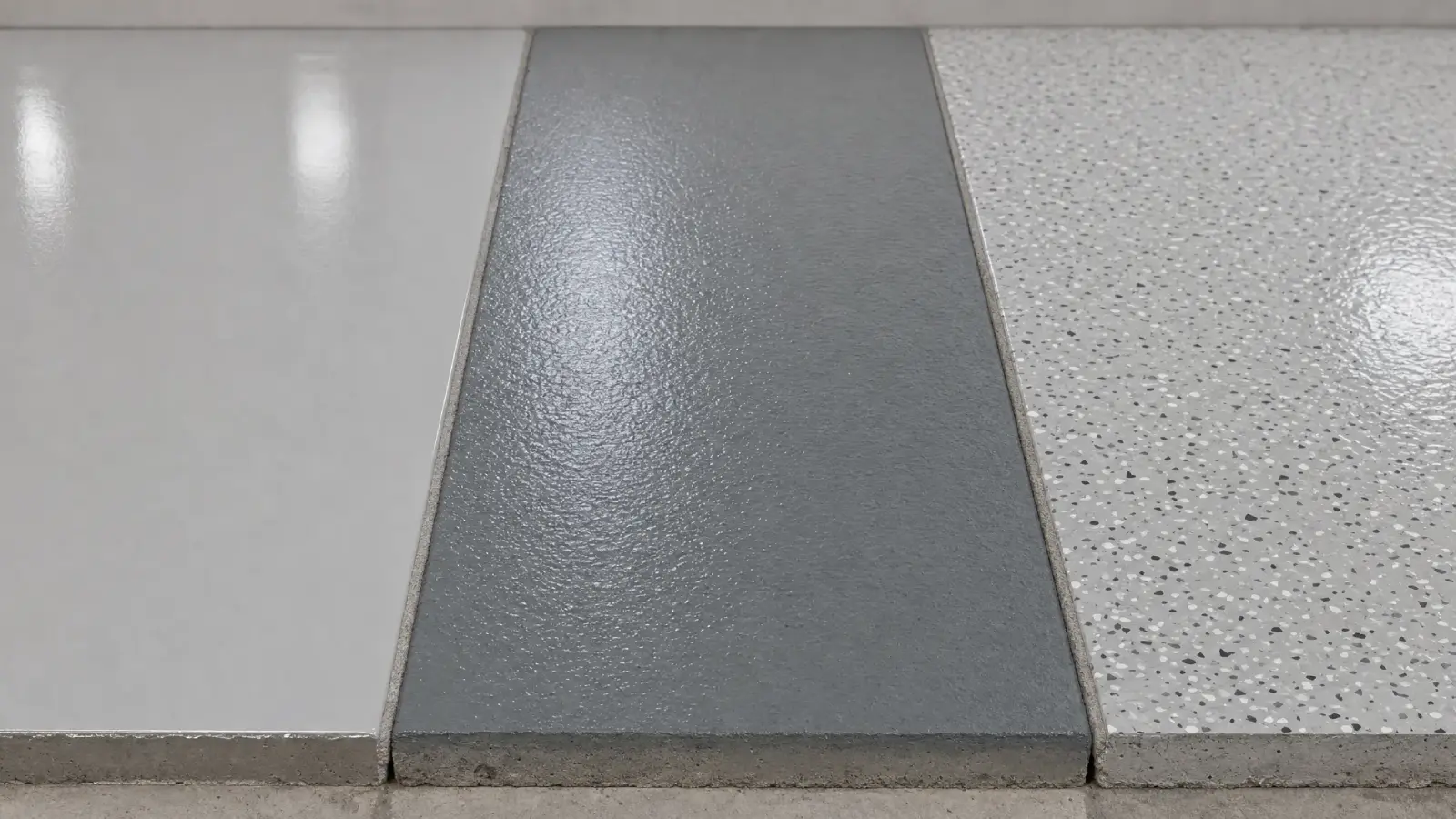
This combined system — polyurea base coat + decorative chip broadcast + polyaspartic topcoat — is the premium residential basement floor coating for Western PA. It addresses all three Pittsburgh-specific challenges:
- Moisture: Polyurea base coat plus optional moisture vapor barrier primer on high-emission slabs
- Freeze-thaw flexibility: Polyurea’s elongation handles slab movement without cracking
- Salt and chemical resistance: Polyaspartic topcoat resists road salt, household chemicals, and staining
Epoxy vs. Polyurea vs. Polyaspartic: How Do They Compare for Pittsburgh Basements?
| Standard Epoxy | Polyurea | Polyurea + Polyaspartic | |
|---|---|---|---|
| Strength | Baseline | 6X stronger | 6X stronger + abrasion resistant |
| Flexibility | Rigid — cracks with slab movement | Flexible — handles freeze-thaw | Flexible — handles freeze-thaw |
| Moisture resistance | Poor without vapor barrier primer | Good; aromatic base resists vapor | Best — full moisture management system |
| UV stability | Yellows; varies by product | Aromatic: yellows in sunlight | UV-stable — no yellowing |
| Cure time | 24–72 hours | Same day | Same day |
| Cost (Pittsburgh installed) | $3–7/sq ft | $5–9/sq ft | $7–12/sq ft |
| Expected Pittsburgh lifespan | 3–7 years typical | 10–15 years | 15–20+ years |
Where Should Pittsburgh Homeowners Invest vs. Save on Basement Floor Coating?
Invest here — these determine whether the coating lasts or fails
- Diamond grinding: Acid etching or surface cleaning is not adequate preparation for a Pittsburgh basement. Diamond grinding opens the concrete pore profile to CSP-2 or CSP-3, removes surface laitance, and creates the mechanical adhesion profile that holds the coating. Specialty Concrete Coatings includes diamond grinding in every installation — never skip it or accept a substitute.
- Moisture vapor testing: Every Pittsburgh basement slab should be moisture-tested before coating. A calcium chloride test or in-situ RH probe takes minimal time and cost — but skipping it is one of the primary causes of Pittsburgh basement coating failures.
- Moisture vapor barrier primer on high-emission slabs: If moisture testing shows the slab exceeds acceptable vapor emission rates for the coating system, a moisture vapor barrier primer is mandatory. Adding this cost upfront costs significantly less than removing a failed coating and restarting in two years.
Where you have flexibility
- Chip color and density: The decorative chip broadcast affects aesthetics, not performance. Standard chip densities and color combinations perform identically to full-broadcast or custom color systems.
- Gloss level: The polyaspartic topcoat is available in varying gloss levels from satin to high-gloss. Performance is equivalent; gloss is an aesthetic preference.
Specialty Concrete’s approach: Every Pittsburgh basement floor coating estimate includes a free walkthrough, moisture assessment, concrete condition evaluation, and a written quote itemizing prep, system components, and what to expect at each stage. No surprises — you know the full cost before we start.
TL;DR — Basement Floor Coating Options for Pittsburgh, PA
- Standard epoxy fails in Pittsburgh basements within 3 to 7 years — moisture vapor, freeze-thaw slab movement, and road salt create conditions that rigid epoxy cannot handle.
- Polyurea is 6X stronger than epoxy, flexible, and moisture-resistant — the right base coat for Western PA’s conditions.
- A polyurea base coat + polyaspartic topcoat system is the best-performing option for Pittsburgh basements — UV-stable, 15 to 20+ year lifespan, resistant to moisture, salt, and chemical exposure.
- Diamond grinding and moisture testing are mandatory first steps — never accept a Pittsburgh basement coating estimate that skips them.
- Cost: $3–7/sqft (standard epoxy) to $7–12/sqft (professional polyurea/polyaspartic system) installed in the Pittsburgh market. Specialty Concrete Coatings provides free on-site estimates.
- Contact Specialty Concrete Coatings for a free Pittsburgh basement floor coating assessment.
Frequently Asked Questions
Which basement floor coating is best for Pittsburgh, PA?
A polyurea base coat with a polyaspartic topcoat is the best-performing system for most Pittsburgh basements. Pittsburgh’s 84% winter humidity, clay-heavy soils, and freeze-thaw cycles create conditions that standard epoxy fails in within 3 to 7 years. Polyurea is 6X stronger than epoxy, flexible enough to handle concrete movement through freeze-thaw cycling, and formulated to resist the moisture vapor that causes epoxy to blister and delaminate in Western PA. The polyaspartic topcoat adds UV stability and abrasion resistance for a system that lasts 15 to 20+ years in Pittsburgh conditions.
Why does epoxy fail in Pittsburgh basements?
Pittsburgh basement epoxy fails for three connected reasons: moisture vapor from clay-heavy soils moves upward through the slab and separates a non-breathable epoxy coating from below; freeze-thaw temperature swings cause the concrete to expand and contract in ways that rigid epoxy cannot flex with, producing cracking and delamination at joints; and road salt tracked in from Pittsburgh streets accelerates any degradation already underway. Without diamond grinding prep, moisture testing, and a moisture vapor barrier on high-emission slabs, most Pittsburgh epoxy installs begin showing failure within 3 to 5 years.
How much does basement floor coating cost in Pittsburgh?
Standard epoxy installs in Pittsburgh typically run $3 to $7 per square foot. Professional polyurea/polyaspartic systems run $7 to $12 per square foot. For an average Pittsburgh basement of 600 to 1,000 square feet, expect $1,800 to $7,000 for standard epoxy and $4,200 to $12,000 for a professional polyurea/polyaspartic system. Specialty Concrete Coatings provides free on-site estimates — contact us to schedule.
Do I need a moisture test before coating a Pittsburgh basement floor?
Always. Pittsburgh basements sit over clay-heavy soils that transmit moisture through the slab year-round. A moisture vapor emission test determines whether the slab requires a moisture vapor barrier primer before the coating system. Applying a coating to a Pittsburgh slab without moisture testing is one of the primary causes of early coating failure in Western PA — the testing costs minimal time and money compared to the cost of removing a failed coating and re-coating.
How long does basement floor coating installation take in Pittsburgh?
Specialty Concrete Coatings completes most Pittsburgh basement floor coating installations in one day, including diamond grinding, crack repair, base coat, chip broadcast, and polyaspartic topcoat. Walk-on time is same-day; the floor is ready for normal use within 12 to 24 hours. Larger basements or those requiring significant concrete repair may require two days.
Related Guides
- Specialty Concrete Coatings — Pittsburgh Commercial Floors
- Garage Floor Coating Pittsburgh PA
- Commercial Epoxy Floor Coating Pittsburgh
- Polyurea vs. Epoxy — Which Is Right for Your Project?
Ready to Coat Your Pittsburgh Basement Floor? Get a Free Estimate
Specialty Concrete Coatings serves Pittsburgh, Allegheny County, and Western PA with professional-grade polyurea and polyaspartic floor coating systems. Every estimate includes a free walkthrough, moisture assessment, and written quote — with transparent line items for prep, moisture mitigation if needed, and the coating system that fits your basement and budget. Get a free quote from Specialty Concrete Coatings today.
About Specialty Concrete Coatings | Specialty Concrete Coatings is a Pittsburgh-based concrete floor coating contractor specializing in polyurea and polyaspartic floor systems for residential basements, garages, and commercial facilities throughout Allegheny County and Western Pennsylvania. Every installation includes diamond grinding surface preparation, moisture assessment, and a warranty. Fully licensed and insured for Pittsburgh commercial and residential projects.